 Tweet
Tweet
Qin was a young military cadet stationed on the border with Russia. Although he was an officer cadet, the alert level on the boarder was not high, and Qin spent most of his days furthering his education and enjoying his family life.
One day Qin's sister Mei returned from a regular trip she would often make with her Mother to the Christian holy city in Russia. Qin's mother side had been long time Christians and Qin followed the Chinese belief to freedom of religion as one of the guiding principals of China. However, Qin could tell immediately that this trip had not been like the previous ones. Mei was in tears and rushed into her room as soon as she returned.
Qin: "Mei! What happened? Was it a boy? Tell me who now! I swear on my honor as your brother I will teach him not to disrespect our family's name!"
Mei: "No brother! It's not a boy. *sob* It's completely different. In the town, on the way back from the shrine...."
Qin: "You mean in Russia?"
Mei: "Yes in Russia! *sob*
Qin: "They hurt you?"
Mei: "No! The Russians didn't do anything to me!"
Qin: "Then tell me what happened! Why are you in tears?"
Mei: "Russia has stationed an army in the Holy City. I saw it on our way back!"
Qin: "I already know that. I hear its a band of rabble."
Mei: "No brother! Don't speak of them like that!"
Qin: "Why?"
Mei: "I was on the road back and I saw their encampment. On one of the banners...*sob*
I saw the family crest of our honorable father!"
Qin: "What!?"
Mei: "They were Chinese! I went into the encampment. They all spoke Chinese! Banner after banner! Lin, Mao, Chi, Dao, and on....all the anicent houses..."
Qin: "There are still Chinese in the central powers army!? But they never returned! We heard they found honorable ends in the Great Wars."
Mei: "Our brothers and sisters. I saw them, our own family is the dog of the Russian Throne!"
Qin: "Mei..."
Mei: "Brother don't you understand! If there's a war we might have to fight our own family! Everything we've been taught is a lie! Russians are not great warriors, they can't even be our friends! They array our own people against us in battle and tell us lies!"
Qin: "Mei..."
I wasn't long before the story reached the top military officers and the Council of the 108 stars. It is said that when Emperor Lao Wai Mo recieved the news that he was so furious that he hurled serveral anicent vases to the floor of the Imperial Residence. A modern day reminder of an anicent past had been brought to the Chinese people. Back to the days of corruption and servitutde. A great debt was owed to the Chinese people, and its proof was in the Holy City....
One day Qin's sister Mei returned from a regular trip she would often make with her Mother to the Christian holy city in Russia. Qin's mother side had been long time Christians and Qin followed the Chinese belief to freedom of religion as one of the guiding principals of China. However, Qin could tell immediately that this trip had not been like the previous ones. Mei was in tears and rushed into her room as soon as she returned.
Qin: "Mei! What happened? Was it a boy? Tell me who now! I swear on my honor as your brother I will teach him not to disrespect our family's name!"
Mei: "No brother! It's not a boy. *sob* It's completely different. In the town, on the way back from the shrine...."
Qin: "You mean in Russia?"
Mei: "Yes in Russia! *sob*
Qin: "They hurt you?"
Mei: "No! The Russians didn't do anything to me!"
Qin: "Then tell me what happened! Why are you in tears?"
Mei: "Russia has stationed an army in the Holy City. I saw it on our way back!"
Qin: "I already know that. I hear its a band of rabble."
Mei: "No brother! Don't speak of them like that!"
Qin: "Why?"
Mei: "I was on the road back and I saw their encampment. On one of the banners...*sob*
I saw the family crest of our honorable father!"
Qin: "What!?"
Mei: "They were Chinese! I went into the encampment. They all spoke Chinese! Banner after banner! Lin, Mao, Chi, Dao, and on....all the anicent houses..."
Qin: "There are still Chinese in the central powers army!? But they never returned! We heard they found honorable ends in the Great Wars."
Mei: "Our brothers and sisters. I saw them, our own family is the dog of the Russian Throne!"
Qin: "Mei..."
Mei: "Brother don't you understand! If there's a war we might have to fight our own family! Everything we've been taught is a lie! Russians are not great warriors, they can't even be our friends! They array our own people against us in battle and tell us lies!"
Qin: "Mei..."
I wasn't long before the story reached the top military officers and the Council of the 108 stars. It is said that when Emperor Lao Wai Mo recieved the news that he was so furious that he hurled serveral anicent vases to the floor of the Imperial Residence. A modern day reminder of an anicent past had been brought to the Chinese people. Back to the days of corruption and servitutde. A great debt was owed to the Chinese people, and its proof was in the Holy City....


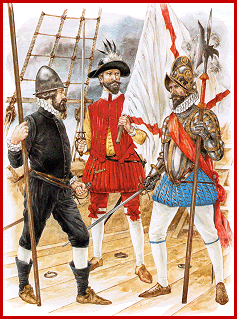 Captain Manning was exiled by the newly elected English Government following a missive sent to the Americans, forcing them into a puppet state of England. Manning took the blame for the entire incident, and was exiled to Spain, where he would be under the care of Prince Carlos VI. Carlos had married the daughter of General Mendoza, a close confidant of Captain Manning, and felt it an honor to house the great English commander. After traveling through the nothern sea to Spain Manning would officially be gone from England forever...
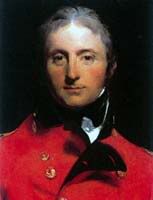 Captain Manning put on his bright red uniform, and surveyed himself in a mirror. The time has come, and he'd have to greet the Prince, he must remain a proper British nobleman; maintain a stiff upper lip. He rose from his chair and opened the door, "I am ready to see the Prince." he said to the Spanish soldier guarding his door, the soldier simply nodded and began to walk.
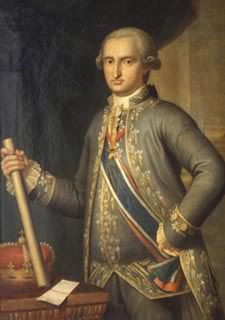 Emperor Carlos VII was a strange choice for the Emperor, but one that the Spanish court believed to be necessary. He would be the first to admit that he knew nothing of governance, and failed to understand the reasons why the Spanish nobility felt that he would rule best; the fact was simply that the nobility wanted a man who would not interfere with the policies of Felipe II and Carlos V. Unfortunately this would not prove to be the case. Rather than feed into the liberal movement in Spain Carlos VII decided to attack decisively, sending a massive army to the colony of San Pedro to crush the rebellion of Simon Bolivar, but more on that later. In order to maintain such a force Carlos VII had to recruit hundreds of thousands of Spaniards, and change laws regarding military officers (until now high ranks had to be filled by noblemen), and turning control of the military over to commoners. While this may have seemed a small victory for liberals in Spain, it resulted in a general feeling of Spanish nationalism that saw the Imperial family as a Spanish institution rather than a tyrannical force.
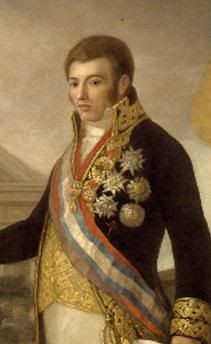 Another change Carlos VII made to the Spanish government was his direct role in running the country. Already delegation of authority had begun under Felipe II, who installed Alfonso Guzman de Olivares as the duke of Toledo, complete with his own Imperial palace at Versailles, and full control over the eastern Empire's military and civilian matters. Carlos VII saw it fit to appoint a minister who would make decisions in his name and generally run the government in his stead; he chose a man named Manuel de Godoy for the job as Prime Minister. Manuel had begun as an aid to Don Cristobal Colon, the former Governor of New Spain. Manuel's duties were simply to run the day-to-day operations of the Governor's office, and report directly to both Governor Colon and Emperor Felipe II on any activities worthy of note. Following Colon's removal from office Godoy returned and begame an influential merchant in Seville before being appointed to the board of directors who devised the Hermitage. He later found favor with Emperor Felipe II just before his death, and thus remained in the Imperial court. Eventually he befriended Carlos VII, and became Prime Minister as one of Carlos' most trusted advisors. His job as Prime Minister would be similar to his job with Governor Colon, except there was a much more prestige and considerably more power.
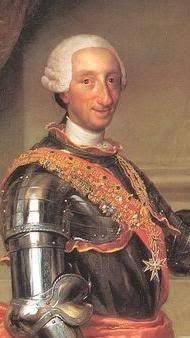 Finally Carlos VII appointed a new Foreign Minister, and in due fashion named his cousin (and son of outgoing Foreign Minister Alfonso Guzman de Olivares) Alfonso Guzman de Olivares II to the position. Alfonso inherited the title "Duke of Toledo," and as such was responsible for the eastern portion of the Empire, with his capital in Toledo itself. Carlos VII felt the job of an Emperor was tedious and figured if he couldn't do the job properly he could just hire people who could. Unfortunately for him, he would reign in an era that seemed, on its face, quite stable. New events would forever change the face of politics on Terra, and Carlos VII didn't seem ready to meet the challenge.
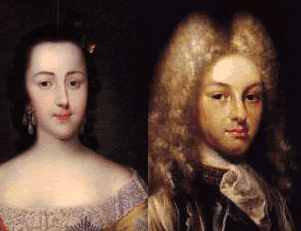 Catherine of Russia assumed the throne being the only living heir to the Russian throne, and unwed; thus she was potentially the final surviving member of the royal family. It was during this time that Spain had begun its slow break from servitude to the Pope in Yaroslav'l. For centuries Spanish missionaries poured over the borders of countries as far as Germany to spread the gospel, giving more and more power to the Pope in Yaroslav'l, which forced Spanish authorities into a horrible inquisition where thousands of Spaniards were killed for both serious and frivilous slights to the Catholic church. Emperor Felipe II realized that the only way to keep Spain happy would be to end the inquisition, but how could this be done without angering the Pope and losing Russian support? Fortunately for Felipe Catherine had acquired the reputation of being very sexually active, to the point of (in many Russian nobles' minds) shame. It was also true that Catherine must provide an heir. Therefore in 1452 it was announced that the Infante Felipe Diaz de Castilla y Aragon III would marry Czarina Catherine, cementing the Spanish-Russian defensive pact for decades, and thus allowing the cancellation of the inquisition. This way, regardless of the Pope's response, Spain and Russia would remain powerful allies.
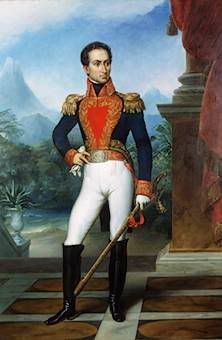 Most would agree that the best explaination is liberalism itself. New ideas of democracy, and social contracts, permeated throughout Spain. Many were compelled to join the Union Liberal, an organization founded by Baltasar Gracian, an outspoken critic of the inquisition (being a priest he was promptly excommunicated by Pope John III). The Union Liberal is basically a think-tank for many Spanish liberals, who advocate a democratically elected government ruled by law, and not by a monarch. It is rumored that the rebel Simon Bolivar of New Spain is funded by the Union Liberal, however this has never been proven. Regardless of this fact Bolivar's rebel forces share the fundamentally liberal values of the Union Liberal, including freedom of religion, freedom of speech, universal sufferage, and the free market. Their ideas have recently become very popular in Spain and can be credited with the new religious freedoms granted by Emperor Felipe II. The fact that Carlos VII has publicly stated that he would not be known as the Emperor who lost the Empire, nearly proves that the recent military improvements may have been, in some way, sparked on by the rise of these rebels of Concordia.
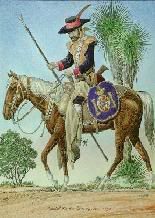 The Spanish cavalry had been assigned to secure settlements in Concordia from barbarian assaults, a rash of which recently plagued the colony of San Pedro. The forces of General DeMores, who had at one time comitted the massacre of San Pedro were now ordered to locate potential rebel safe-houses and supply-lines. In an area as underdeveloped as New Spain, this proved to be quite difficult...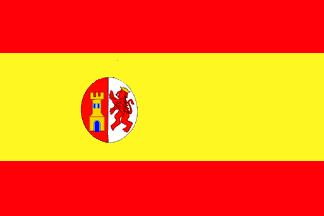
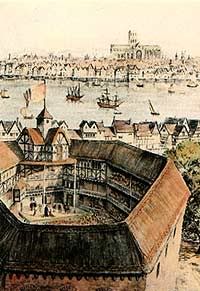 Emperor Carlos VII and his Empress Eugenia sat in awe of the new theatre, and of the production El Canto de Mio Cid which went on before their eyes. Meanwhile in the hallway General Espartero and Prime Minister de Godoy discussed the situation between Russia and China.
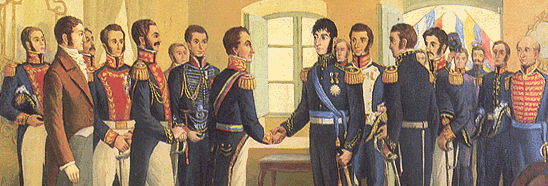 Captain Juan Prim y Prats met with Generalisimo Bolivar in San Pedro on February 18th, 1476 to bring him maps of Imperial supply lines, Papal missionary routes, and falsified military identification, for some unkown purpose.
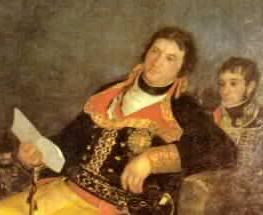 Prime Minister Manuel de Godoy was appointed by Carlos VII in the interest of running the unweildy Empire, which held three capitals and overseas territory. The Emperor admittedly had no interest in running the govenment, and also admitted that he would not be the best man for the job. Manuel made some strides in opening up markets and creating the best economy Spain has seen in her history, but he made one crucial misstep that would end not only his life, but the power of the Empire itself; he engaged in an affair with Empress Eugenia de Barcelona. What this meant for the Empire was quite obvious - clearly if the Prime Minister and the Empress are sleeping together, the Emperor himself is cast as an impotent weakling - something had to be done, but unfortunately for Carlos VII and Manuel de Godoy the Union Liberal had secretly come accross these facts through General Espartero, a member of the Union. General Espartero used the information to extract maps of supply-lines, military positions, official Holy See information, state secrets, and identification papers as well as units deployed under his direct command all funded by the Emperor Carlos VII. All of this information would prove disastrous for the Imperial authorites, and would indirectly lead to the death of Phillip IV.
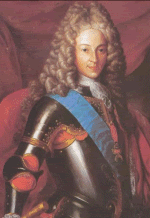 Phillip IV spent most of his life studying in Russia, but would spend his final days in the Spanish colony of San Pedro. He was the son of Catherine the Czarina of Russia and Felipe III, son of Emperor Felipe II. In 1490 it was determined that Phillip should become the Viceroy of New Spain, especially after the botched rule of Governor Cristobal Colon. Phillip IV was not much more effective than Colon, as he quickly went under the sway of Captain Juan Prim y Prats, another Union Liberal agent working in the military. Captain Prim y Prats convinced Phillip that Simon Bolivar wasn't a bother and further suggested he move troops from San Pedro to the German colony of Bremen, claiming that the new colony was a sign that Germany had ambitions aims towards New Spain; Phillip fell for the ruse entirely and the armies of Bolivar approached the city and demanded Phillip IV turn himself over to be tried for treason against the Spanish people and the Spanish Republic. Obviously Phillip scoffed at such a notion, boasting "your pathetic rabble will never encroach upon San Pedro!" The stage was set for a showdown, as Phillip called upon Captain Prim y Prats and his imperial forces to come to the defense of the city. These defenses never came.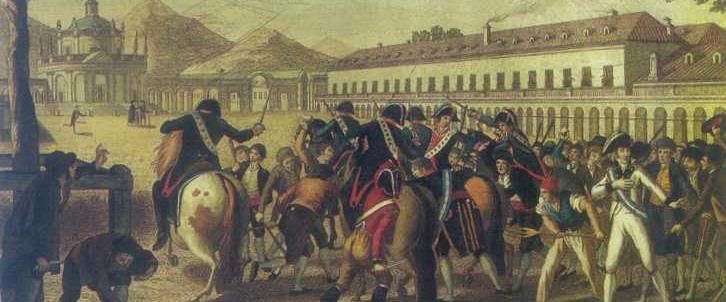
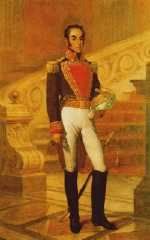 Bolivar's forces routed the under-prepared, and outclassed forces of Phillip, the bulk of the army was with Captain Prim y Prats watching the colony of Bremen. The Liberals captured the Viceroy, held an ad hoc trial, and summarily executed him in the imperial palace. Word quickly reached both Russia and Spain, who condemned the actions and swore revenge on Simon Bolivar for the murder of Phillip. Luckily for the Emperor the build up of soldiers at Bremen sparked tension between Germany and Spain, and there were already imperial forces on their way to New Spain. Captain Prim y Prats warned Bolivar of the oncoming army, and he quickly abandoned San Pedro before the Imperial troops could arrive. While the New Spanish Republic was short-lived it proved that rebellion was possible, and that the Imperial Authority was dwindling. Add to this the new tension between Germany and Spain and the Liberals were in a position they finally thought they should cash in on. General Espartero had the Prime Minister under his complete control, Captain Prim y Prats was on the inside of the military situation in New Spain and was feeding information to Simon Bolivar, so finally a meeting had to be called to order...
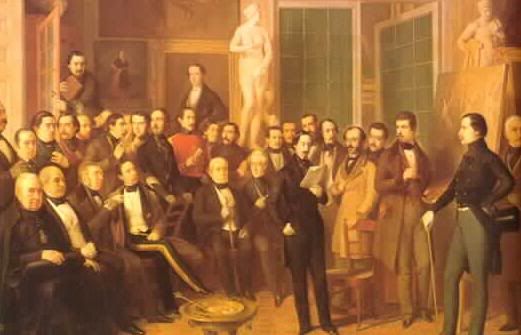 In January of 1554 the top members of the Union Liberal met in Toledo to discuss their next moves, Simon Bolivar was even smuggled in on the same ship that brought Captain Prim y Prats to the meeting. The discussion was obvious; when and where do we finish our work? However things were not that simple, while the men all agreed that they wanted a Spanish Republic, none of them could agree on how they would administer the new government or who would run it. There was even debate out potentially breaking Spain into three seperate republics with capitals in Madrid, San Pedro, and Toledo respectively. There were even questions about the loyalty of the troops under Prim and Espartero's command. Clearly nothing was going to be decided in this type of environment until General Espartero suggested that they install their own Prime Minister, he assured the assembly that if Emperor Carlos VII found out that Eugenia and Manuel de Godoy were lovers he would certainly kill Manuel, and he felt that he could convince the Emperor to appoint him to Prime Minister, thus giving him official power that could then be used to overthrow the Imperial government. Thus the plot was afoot.
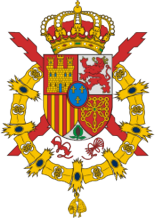
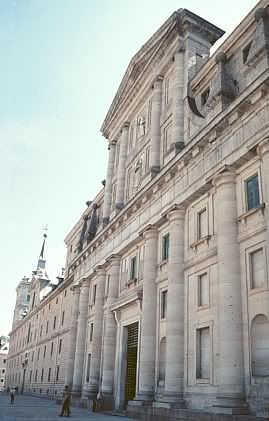 Emperor Carlos VII, General Carlos VI, and the exiled Captain William Manning all sat over late-night wine from Seville as they discussed the latest events transpiring in Spain; quite honestly the discussion became a bit tense when the issue of the "Zaragosa Incident" came up...
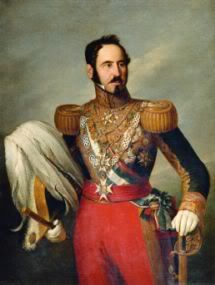 General Espartero entered the room hurriedly, as far as the three men in the room were concerned at least, in actuality he was a top member of the Union Liberal and a key agent in their rebellious activity, especially in New Spain "Sire, this is a matter of dire importance, you would be wise to hear this in private." he began.
Comment