
 Tweet
Tweet

TO: Wilhelm Lord Protector of Berlin.
CC: Inca, England, Russia, Spain, China
FROM: Rajaraja, First Consul for Life of India
It has come to our attention that Germany is maintaining a large mercenary force that it is making available to all nations. We were taken quite by surprize by such a large German force outside of the Indian city of Boston. They did seem to be quite a large and impressive force.
In light of assurances from several German representatives that Germany had no role in planning the invasion of India, and were merely pursuing a purely neutral business arrangement with America, India is similarly interested in pursuing a business arrangement with Germany.
To the point - we wish to hire the German mercenaries we observed so impressively under American command just a few years ago. We intend to use that army to retake Boston - and perhaps additional territory - from the Americans.
Please inform us of what the Americans paid you, and the other terms of that deal, and we will match it.
- Rajaraja, First Consul for Life of India

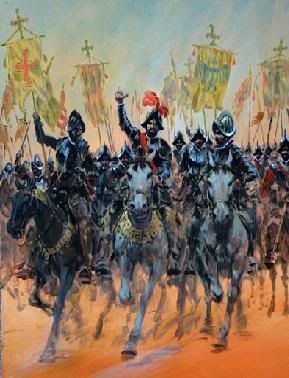 Olivares' army routed the Spanish troops stationed to protect Madird. Generals Francisco Pizarro and Hernan Cortez were captured and imprisoned, along with numerous nobles who were aligned with Ferdinand. Many of the citizens, who were predominately Buddhist, went over to Olivares' side against King Ferdinand, who had escaped to Seville at the behest of his chief advisor Salvadar Duarte de Sevilla. With the people on his side Olivares was easily able to enter the Citadel and capture the King's top aides and allies.
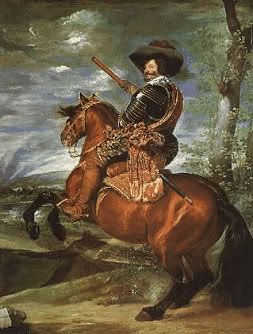 Olivares then had himself proclaimed Emperor of Spain, naming his son Agosto heir to the throne. He even went so far as to adopt the title "El Cid" in celebration of his attack on Madrid and the fall of Ferdinand (he likened the assault on Madrid to El Cid's assault on Madrid which ousted the tyrant Bainor). He even allowed for the safe return of his "brother" Carlos V, what he didn't realize is that Carlos' return would be dangerous for him, and not Carlos V. Carlos V rallied his exploratory force to return to Spain and depose Olivares. Carlos found it difficult to gain support among Spain's ruling elite, who were Hapsburgs and reluctant to help Carlos because of his ties to the house of Bourbon, despite the fact that Carlos himself is a Hapsburg. When Olivares discovered Carlos designs, who realized he had to act quickly, and in a show of power found Ferdinand and had him executed in a humilating fashion (the display was said to have made Isabella II pass out.) Carlos was enraged, and marched his army north towards Toledo, gaining support from Incan slaves which he promised to grant freedom to once he was installed as King.
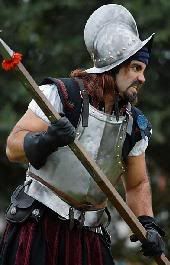 Olivares decided it would be best to meet Carlos before he reached Madrid, and marched an army from Cordoba, meeting him in the plains north of Salamanca. The two armies clashed violently, with the Conquistadors under Carlos gaining ultimate victory. Carlos realized in order to keep Spain under control he had to let Olivares live, this way his enemies could not make a martyr of him. He didn't do much to change the policies of Olivares, but he made great strides in setting the nobles into his favor, and establishing a stronger position for himself within the Catholic Church by naming himself the Holy Spanish Emperor and giving himself officially recognized church position as a divine ruler. Carlos decided it was time to revitalize the Spanish military, claiming that the projects of Isabella and Sancho were costing more money than was necessary, and were only begun to establish a positive historical view of the rulers. Carlos managed to establish a strong military sense in the Spanish Empire, one that would continue for centuries and help Carlos establish himself as one of the finest Spanish monarchs that ever ruled.

Comment