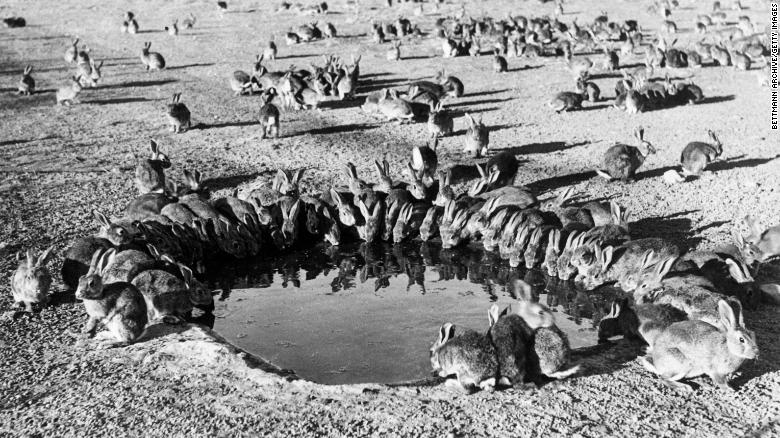
(CNN)What seemed like an innocent Christmas gift of 24 English rabbits in 1859 would go on to become Australia's "most devastating biological invasion," according to a new study by the Proceedings of the National Academy of Sciences.
Wild rabbits are not native to Australia and are considered an invasive species. Farmers say the animals multiply quickly and destroy their crops and land, which can lead to massive soil erosion and other environmental issues.
"Biological invasions are a major cause of environmental and economic disruption," researchers wrote.
"(And) the colonization of Australia by the European rabbit is one of the most iconic and devastating biological invasions in recorded history."
Using historical accounts, researchers were able to piece together genetic evidence linking this invasion to English rabbits imported in 1859 by a settler named Thomas Austin, tracing the population back to Austin's birthplace in England.
According to historical records, Austin had started off with just 24 rabbits on his sprawling Melbourne estate. But within three years, the animals had multiplied into the thousands -- and kept on breeding, researchers noted.
"Our findings show that despite the numerous introductions across Australia, it was a single batch of English rabbits that triggered this devastating biological invasion -- the effects of which are still being felt today," said lead author Joel Alves, also a researcher at the University of Oxford.
"That single event triggered this enormous catastrophe in Australia; the fastest colonization rate for an introduced mammal ever recorded."
(...)
Wild rabbits are not native to Australia and are considered an invasive species. Farmers say the animals multiply quickly and destroy their crops and land, which can lead to massive soil erosion and other environmental issues.
"Biological invasions are a major cause of environmental and economic disruption," researchers wrote.
"(And) the colonization of Australia by the European rabbit is one of the most iconic and devastating biological invasions in recorded history."
Using historical accounts, researchers were able to piece together genetic evidence linking this invasion to English rabbits imported in 1859 by a settler named Thomas Austin, tracing the population back to Austin's birthplace in England.
According to historical records, Austin had started off with just 24 rabbits on his sprawling Melbourne estate. But within three years, the animals had multiplied into the thousands -- and kept on breeding, researchers noted.
"Our findings show that despite the numerous introductions across Australia, it was a single batch of English rabbits that triggered this devastating biological invasion -- the effects of which are still being felt today," said lead author Joel Alves, also a researcher at the University of Oxford.
"That single event triggered this enormous catastrophe in Australia; the fastest colonization rate for an introduced mammal ever recorded."
(...)
Rabbits of Doom!







Leave a comment: