The Altera Centauri collection has been brought up to date by Darsnan. It comprises every decent scenario he's been able to find anywhere on the web, going back over 20 years.
25 themes/skins/styles are now available to members. Check the select drop-down at the bottom-left of each page.
Call To Power 2 Cradle 3+ mod in progress: https://apolyton.net/forum/other-games/call-to-power-2/ctp2-creation/9437883-making-cradle-3-fully-compatible-with-the-apolyton-edition
The first time Nessie O’Neil witnessed a pygmy raccoon making a toy ball out of trash, she didn't realize that she'd just made a major scientific discovery.
"My first thought was, oh my gosh, this is adorable," O’Neil, a biologist at Miami University in Ohio, told As It Happens host Nil Köksal.
Then she showed the footage to her advisor.
"She was like, 'Nessie, this is very important. Do not post this on social media because we need to write a paper about this.'"
That paper, now published in the journal Wild, documents the itty bitty Mexican critters rummaging through bins for paper and other materials, crafting those scraps into balls to play with, and teaching their family members how to do the same.
The authors say this is first documented evidence of “material culture” — socially shared cultural information about objects — in the Procyonidae family, which includes raccoons, ringtails and other similar creatures.
"We know that raccoons are very playful animals. If you give them a cat toy, they will bat it around or chew on it and chase it," O'Neil said. "But up until now, we have not seen anything like this."
Pygmy raccoons are a critically endangered species found only on Cozumel Island off the coast of the Yucatan Peninsula in Mexico.
Weighing about three to four kilograms, they are much smaller than the chunky mainland raccoons who dwell in Canadian and American cities. They have long limbs, which they use to navigate their native mangrove forests and forage for crabs and other shoreline prey.
But as their natural habitat is increasingly razed for development, O'Neil says they've turned to tourist scraps and to garbage bins for sustenance.
In fact, O'Neil was observing a family of raccoons at a beach club when she first witnessed the toy-making behaviour.
"I actually saw one of the juveniles go into a trash can and dig through and pull out a rather long receipt. And she brought the receipt back to a stainless steel water bowl that one of the staff members had put out for her and began to dunk it in the water," she said.
"She started to roll it between her hands and shape it into a ball. And then she would roll it in the sand and maybe dump it back in the water a little bit and then go back to the sand and work on shaping it. And after she got it how she wanted it, she began to play with it like a cat with a little mouse toy."
Then, O'Neil says, she shared her skills.
"Her sister learned how to do this behaviour, too. She would watch and practise alongside her," O'Neil said.
The mother raccoon also tried to make a ball, the study noted, but gave up when was unable to retrieve her paper towel from the water dish.
"The success of the mother during this attempt might have been influenced by her earlier consumption of one ounce of a margarita, which appeared to lower her dexterity," the study reads. Novel behaviour
Benjamin Beck, a retired scientist from the Smithsonian Conservation Biology Institute and co-author of the book Animal Tool Behavior, says he's seen many instances of animals playing using random objects as toys.
But he says he's never heard of an animal making its own toy.
"I think it's a distinct category to say that you made your play toy as well as used your play toy," he said. "What that distinction means, I'm not absolutely sure. Maybe it suggests a higher level of foresight and creativity."
What's even more interesting, he says, is that the raccoons were seen batting the ball back and forth between each other.
"That's social object play," he said. "And that I have no record of."
Still, he says, he'd be hesitant to label the behaviour as an example of culture, given the small sample size.
"You're going to have to look at a sequence of generations to make sure that the behaviour persists, it is being learned intergenerationally, before you can make the leap to any sort of culture," he said The plight of the pygmy
There are only 200 pygmy raccoons alive today in Cozumel, and O'Neil says those numbers are shrinking as tourist developments destroy their habitat and cut them off from their natural food supply.
In fact, the pygmy raccoon O'Neil first filmed making a paper ball has since died.
"She was so malnourished due to eating almost nothing but tortilla chips," she said.
O'Neil says she hopes this research will shed light on the plight of pygmy raccoons, and inspire people to change their behaviour — especially tourists.
"People need to stop feeding them. Stop feeding them tortilla chips. Stop offering them margaritas. Stop supporting resorts and beach clubs that are destroying their homes," O'Neil said.
"Every animal has an intrinsic value. Even if humans can't see it, they have a right to be there. This is their home."
A new study shows pygmy raccoons in Mexico rummaging through bins for paper and other materials, crafting those scraps into balls to play with, and teaching her family members how to do the same.
I am not delusional! Now if you'll excuse me, i'm gonna go dance with the purple wombat who's playing show-tunes in my coffee cup!
Rules are like Egg's. They're fun when thrown out the window!
Difference is irrelevant when dosage is higher than recommended!
Ontario police rescue racoon that became trapped in Highway 403 sewer grate
A racoon that got stuck in a sewer grate on Highway 403 last week is free once again.
On Tuesday, Ontario Provincial Police (OPP) told CTV News Toronto that they started receiving calls just after 5 p.m. on Sept. 15 about a trapped animal on the highway in Burlington.
Responding officers searched the area and located the raccoon just before 6 p.m. on a narrow shoulder of the 403, near Highway 407.
“They were able to open the catch basin and free the raccoon and cleared the area at 6:10 p.m.,” Const. Rob Tihor said in an email.
The raccoon, who police referred to as Rocky, was seemingly unharmed and left the scene shortly after.
A racoon who got stuck in a sewer grate on Highway 403 last week is free once again.
I am not delusional! Now if you'll excuse me, i'm gonna go dance with the purple wombat who's playing show-tunes in my coffee cup!
Rules are like Egg's. They're fun when thrown out the window!
Difference is irrelevant when dosage is higher than recommended!
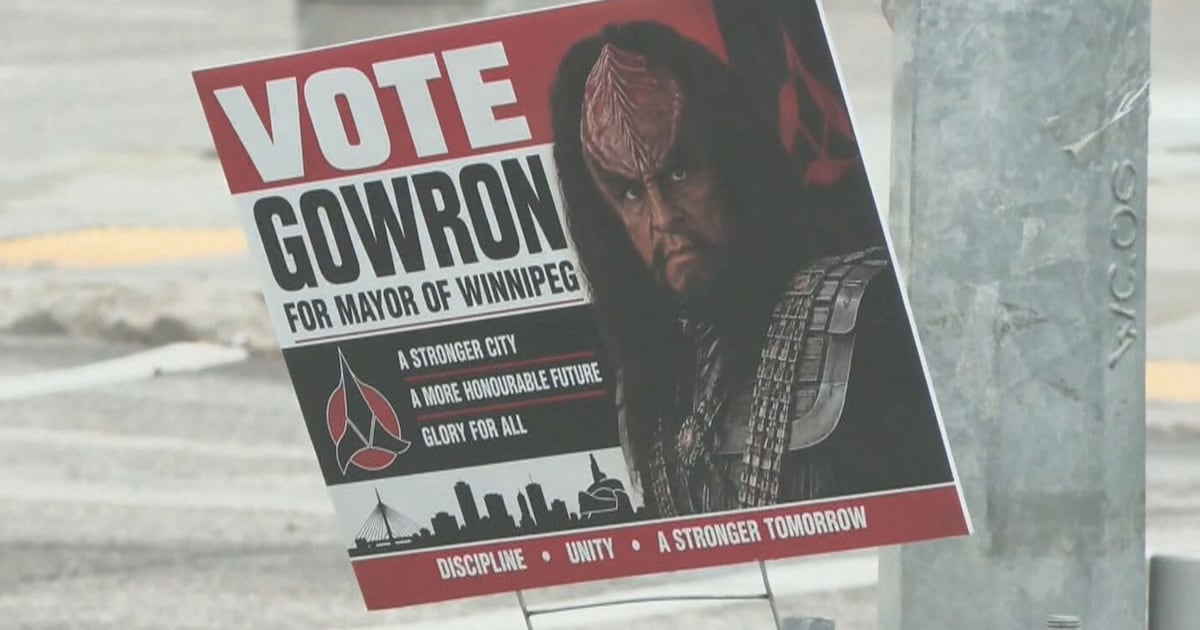
A poster in Winnipeg is endorsing Gowron, the leader of the Klingon Empire in Star Trek, as a choice for Winnipeg's mayor.
I am not delusional! Now if you'll excuse me, i'm gonna go dance with the purple wombat who's playing show-tunes in my coffee cup!
Rules are like Egg's. They're fun when thrown out the window!
Difference is irrelevant when dosage is higher than recommended!
I live in Winnipeg. Unfortunately, Gowron didn't submit the paperwork and won't be appearing on the ballot. Our system does not allow 'write-in' votes.
I always wondered about Klingon evolution, mainly wether those foreheads were a result of banging them together over millenia, or if they had them foreheads in the first place and started to bang them together once their ancestors found out they can deal with it. Kinda chicken/egg, just with foreheads
Plus there's always the TOS vs. later foreheads mystery. Which I think was explained in a later show by sufficient ST stuff, but I forgot the idea behind it
Priest killed by falling crucifix during live streamed Mass
A priest has been killed by a falling crucifix at a church in Ecuador as he performed a mass that was being live streamed online.
Patricio Alfredo Sánchez Molinari died on Saturday at the Perpetuo Socorro church in the city of Guayaquil, southern Ecuador, according to a statement from the city’s archdiocese, published on Facebook on Monday.
Video of the incident shows Sánchez leading the mass when a large wooden cross that was standing on the altar behind him falls over and hits him on the head.
Shouting can be heard from the congregation, and several people enter the frame and rush toward the priest.
On Sunday, the church held a eucharist in memory of Sánchez, led by Cardinal Luis Cabrera, archbishop of Guayaquil.
“We are grateful for all of the condolences from around the world, and especially for your prayers for the eternal rest of the soul of Patricio Sánchez,” the statement reads.
According to CNN affiliate Ecuavisa, the priest was preparing to lead a wedding ceremony when the tragedy occurred.
Police have not commented on the incident so far, Ecuavisa reported.
CNN has reached out to the Archdiocese of Guayaquil for comment.
A priest has been killed by a falling crucifix at a church in Ecuador as he performed a mass that was being live streamed online.
I am not delusional! Now if you'll excuse me, i'm gonna go dance with the purple wombat who's playing show-tunes in my coffee cup!
Rules are like Egg's. They're fun when thrown out the window!
Difference is irrelevant when dosage is higher than recommended!
A Las Vegas court convicted an Ontario man of animal cruelty charges Monday for snatching a flamingo named Peachy from its habitat at an iconic Las Vegas hotel in what prosecutors called a drunken and malicious act.
Mitchell Fairbarn was accused of "willfully, unlawfully, maliciously and feloniously" injuring the flamingo in the early morning hours on March 3, according to the indictment viewed by CBC News. He pleaded not guilty and his trial started last week.
After jurors returned convictions on felony and misdemeanor animal cruelty counts, Fairbarn remained in custody pending a Dec. 1 sentencing hearing. He faces up to four years in prison for the felony conviction, plus six months of jail time for the misdemeanor conviction.
"I thought it was something that we could joke about for the rest of our lives," Fairbarn, described by various Las Vegas media outlets as a contractor from rural Ontario, said in court Friday.
Fairbarn told the court that on the day of the incident, he drank "30 to 40" beers over the course of 24 hours while he was in Las Vegas for a construction expo, he said in video footage of the trial posted by multiple media outlets.
Fairbarn entered the flamingo habitat at the Flamingo Las Vegas Hotel and Casino around 5 a.m. on March 3, according to the Las Vegas Review-Journal, and took the bird because he thought it would be a "silly joke" with his friends.
"I thought it would be, at the time, funny," Fairbarn said.
The Flamingo's wildlife habitat, which the hotel says spans four acres and is certified by the National Wildlife Federation, is home to the resort's namesake Chilean flamingos, among other birds, turtles and fish.
Peachy was shaking, bleeding: witness
Video played at the trial showed Fairbarn holding the flamingo by the neck in an elevator and carrying it down a hotel hallway. He spent about 15 minutes with the bird, and two-to-three minutes with it in his room, reported 8NewsNow, citing police evidence heard in court.
Two of Fairbarn's friends testified earlier this week that they had been out drinking, then woke up in their hotel room to find the flamingo there before moving it to the hallway, notes Fox 5 Las Vegas.
A hotel facilities engineer searching for Peachy eventually corralled the bird into a corner with a towel, and told the court Peachy was shaking and bleeding.
The flamingo was injured during the incident, suffering seven to eight missing feathers, broken feather shafts and blood loss consistent with trauma, the bird's treating veterinarian testified in court, according to Fox5 Las Vegas.
Peachy, who is 27 years old, needed antibiotics, anti-inflammatories and weeks of pain medication, the news outlet reported.
CBC News has reached out to the Las Vegas Justice Court for access to court filings and has not yet received them. But multiple local media outlets present in court have aired footage from court where Fairbarn doesn't deny his actions — just his intent.
His lawyer Joshua Tomsheck said Monday it was a drunken act and no harm was intended. When Tomsheck asked Fairbairn Friday if he had any malicious intent "in your mind or your heart when you picked up that bird," Fairbarn shook his head and answered, "no."
CBC News has reached out to Tomsheck, but has not yet received a response.
Justice delivered: animal rights advocate
Prosecutors said Fairbarn willfully caused the bird physical pain, noting feathers were found on the hotel floor and video showed the bird squawking while Fairbarn handled it. But Tomsheck said his client regrets his actions while intoxicated and never meant to harm the bird, a key element in the felony charge.
"He should not have done that, should not have gone into the habitat, shouldn't have touched a bird, shouldn't have taken Peachy inside," Tomsheck said in court Monday.
"The truth is, Mitch was drunk. Mitch was stupid. He made bad decisions."
Fairbarn told the court Friday that he has remained under house arrest in Nevada since the incident. Court records viewed by CBC News show he had to surrender his passport as one of his bail conditions.
Jurors began deliberations after both sides presented closing arguments Monday morning.
Peachy has since recovered and is doing well, a spokesperson for Caesars Entertainment told CBC News Tuesday.
"We are grateful this matter was taken seriously and appreciate the work of law enforcement, prosecutors and the animal care professionals who responded," the spokesperson said.
"This was a deeply upsetting incident, and our focus remains on the care and well-being of the animals at the Flamingo Wildlife Habitat."
Nevada animal rights advocate John Waudby, who recently helped strengthen the state's animal cruelty laws, told The Associated Press he believes justice was delivered on Peachy's behalf.
"I hope this sends a message to anybody else that wants to mess with our animals, that you're not going to do it in Nevada," he said outside the courtroom after Monday's verdict.
The flamingo is just one of several recent cases involving animal cruelty at Las Vegas casinos, reports the Las Vegas Review-Journal.
In June, a woman was charged after allegedly jumping into the fountain at The Venetian and grabbing a duckling named Daffy. In May, a teen girl was arrested and accused of stabbing three horses the the South Point Arena & Equestrian Center so they couldn't compete in a barrel race.
A Las Vegas court convicted Ontario man Mitchell Fairbarn of animal cruelty charges Monday for snatching a flamingo named Peachy from its habitat at the Flamingo Las Vegas Hotel and Casino last March in what prosecutors called a drunken and malicious act.
I am not delusional! Now if you'll excuse me, i'm gonna go dance with the purple wombat who's playing show-tunes in my coffee cup!
Rules are like Egg's. They're fun when thrown out the window!
Difference is irrelevant when dosage is higher than recommended!
Last year I visited folks in south-Krautland and they told me someone had stolen a Penguin from the local zoo
The Bibs has also this bit on torturing immortal animals
The tiny translucent jellyfish Turritopsis dohrnii is surprisingly hard to kill. The marine biologist Maria Miglietta of Texas A&M University at Galveston has cut them, boiled them, starved them, overloaded their tanks with salt or plopped them in fresh water – but the nifty creatures seem to cheat death every time.
The immortal jellyfish is capable of winding back its lifecycle to become young again. Scientists are unlocking its cellular secrets to find ways human cells could rejuvenate too.
Italian men return wedding ring while dressed as hobbits
Irish man Patrick Mohr took his family to Italy on vacation, and while he was playing with his kids, his wedding ring betrayed him, slipping off into the waters of the Serchio River.
Mohr assumed the golden ring was lost forever.
I just stood there a little bit paralyzed with instant knowledge it's gone. I didn't see much hope in it.
But Mohr's wife had a different mindset. She knew that all she had to do was decide what to do with the time that was given her.
With 16 years of marital memories shining like the light of Eärendil's star, she approached three Italian men at the river and asked them to help find the ring.
Filippo Palagi, Nicola Malloggi, and Edoardo Poggi didn't see much hope in the quest, but as J.R.R. Tolkein fans, they decided to keep up the search after the family had gone back to Ireland.
They used ropes to anchor themselves to boulders and dived into the water wearing scuba masks, eventually focusing their efforts on a stretch of rapids where the current was particularly strong.
Then, in what Palagi described as an 'unbelievable' moment, Malloggi spotted a glint of light on the riverbed. Without hesitation, he reached out and grabbed the gleaming object.
Against all odds, it was the ring.
They texted a photo to Mohr with a picture of the ring, and the following announcement:
Hi Sméagol, look what we found!
‘I put the phone back in my pocket and kept stirring the pasta pot in shock,' said Mohr. ‘My wife looked at my expression on my face and asked me what happened.'
When he showed his wife and daughters the message, disbelief quickly turned to elation, and ‘chaos ensued.'
‘It's such an improbable story,' he said. ‘The guys most certainly didn't have to look for us, and when they found it, they wanted to get in touch with me to tell me.'
The Italians then travelled to Ireland, dressed in costumes as Frodo, Merry, and Sam the hobbits . As they approached the Shadow of Mohr's door, they played music from The Lord of the Rings to really set the mood.
Mohr then took them to Glendalough, a famous lake and monastic site dating back more than 1,000 years, and the neighboring valley of Glenmalure, so they could work in some elvish sounding site-seeing into their trip.
Then they stopped for pints at Mohr's favorite pub.
Palagi is amazed that a chance encounter has turned into an extraordinary friendship.
‘Before that, we never knew each other, [but] now, we have a family in Ireland,' he said.
And Mohr said he's gained a new belief in human kindness.
‘Sometimes you have to let go of control, sometimes you have to put things out into the universe and ask for help,' he said ‘And sometimes, you get an answer.'
I guess it's like Gandalf says in Peter Jackson's version of the The Hobbit,
"Some believe it is only great power that can hold evil in check, but that is not what I have found. It is the small everyday deeds of ordinary folk that keep the darkness at bay. Small acts of kindness and love."
Libraries are state sanctioned, so they're technically engaged in privateering. - Felch
I thought we're trying to have a serious discussion? It says serious in the thread title!- Al. B. Sure
A Calgary family is giving thanks after they discovered an old box of Pokémon cards worth roughly $48,000 during Thanksgiving dinner.
Kirk Ledene was visiting his parents on the holiday when his mother asked him to go through some of his old boxes left in the basement.
He went down and found an old wooden box he'd made in shop class. Inside were some old hockey trophies as well as items he'd purchased at an auction house he worked at in the early 2000s.
And buried amongst the long-neglected items was an unopened box of Pokémon cards.
He brought the finds upstairs to show his kids.
“I showed the trophies off to the kids, and their jaws dropped when they saw the box in my hand,” said Kirk.
An initial search online revealed the box in question — a Wizards of the Coast Night booster box from 1999 — could be worth tens of thousands of dollars.
“It basically became like a piece of China, like don't touch it, don't breathe on it,” said Kirk.
Colleen Ledene, Kirk’s wife, was skeptical at first. “The only thing we talked about at Thanksgiving dinner was this stupid box,” she said. “At first I was like, this is really silly."
But she slowly started to realize it was actually a life-changing find.
Online world of collecting
Next, the family dove into the online world of collectible cards, something that was entirely foreign to them.
They first reached out to auction houses and started to receive messages from interested buyers via social media after their son made a TikTok about the discovery.
After a lot of messaging and searching across social media platforms the couple found a collectibles dealer in Los Angeles — Edward Heikali, who runs E&A Collectibles. Since starting the business in 2020, he has focused on sealed vintage items, just like the box of Pokémon cards the Ledenes found.
“The value of it now is somewhere around the $40,000 US range and it's been steadily going up,” said Heikali.
The value of such boxes is dictated by basic supply and demand and the possibility that the cards within are themselves valuable, said Heikali.
He says stories like the Ledenes' happen quite often.
“A lot of the business that we do is helping people like Colleen that find these things and they then find us,” said Heikali.
For the Ledenes, choosing a buyer and deciding whether to ship or travel with the box to make the sale was a lot to think about.
“There's so many, like, logistical things and you know, like, customs or tariffs and stuff you don't know about or you have to think about,” said Kirk.
In the end they felt comfortable with Heikali and agreed to ship him the box via UPS.
“We just trusted this guy a lot,” said Kirk. "He would send all the forms that would be needed at customs so that just kind of relaxed both of us, making us know that he's done this a few times.”
The fact that Heikali operates a business and is not just an individual buyer also put their minds at ease.
Timing could not be better
The box has now been shipped and the Ledenes are anxiously awaiting the wire transfer.
Heikali says he'll look to sell the box to a collector or another business.
“It'll likely go to someone who's going to open it himself or to a business that is going to open it on behalf of their customers,” said Heikali.
For Kirk and Colleen, the timing of the discovery couldn’t be better.
"It felt like a little bit of an answered prayer ... just with everything going on in our life right now," Colleen said.
They don't know exactly what they'll do with the windfall, but a down payment on a new house, a family trip, and a dinner out with the folks — to thank them for not throwing out the box years ago — are all in the cards.
A Calgary family is giving thanks after they discovered an old box of Pokémon cards worth roughly $48,000 during Thanksgiving dinner.
I am not delusional! Now if you'll excuse me, i'm gonna go dance with the purple wombat who's playing show-tunes in my coffee cup!
Rules are like Egg's. They're fun when thrown out the window!
Difference is irrelevant when dosage is higher than recommended!
 Tweet
Tweet




Comment