-
I have bad news for some Poly posters
Those typing monkeys will never produce Shakespeare’s works, mathematicians say
By Amarachi Orie, CNN
3 minute read
Published 12:08 PM EDT, Fri November 1, 2024

Researchers from Australia have rejected the Infinite Monkey Theorem as "misleading."
Independent Television News/Shutterstock Sign up for CNN’s Wonder Theory science newsletter. Explore the universe with news on fascinating discoveries, scientific advancements and more.
CNN —
Talented though they may be, monkeys will never type out the complete works of William Shakespeare, or even a short book, a new study suggests.
The Infinite Monkey Theorem is a famous thought experiment that states that a monkey pressing random keys on a typewriter would eventually reproduce the works of the Bard if given an infinite amount of time and/or if there were an infinite number of monkeys.
However, in the study published in the peer-reviewed journal Franklin Open, two mathematicians from Australia’s University of Technology Sydney have rejected this theorem as “misleading” within the confines of our finite universe.
They challenged it by looking at the Finite Monkeys Theorem, in which there is a finite amount of time and a finite number of monkeys.
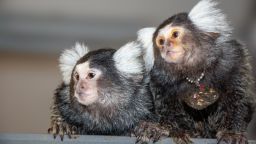
Related article These monkeys use names to communicate with each other, study finds
They took the assumption that the current population of around 200,000 chimpanzees would remain the same over the lifespan of the universe of one googol years (that’s 1 followed by 100 zeros). They also assumed that each chimpanzee would type one key per second for every second of the day, with each monkey having a working lifespan of just over 30 years.
Using these assumptions, the researchers calculated that among these randomly-typing monkeys, there is just a 5% chance that a word as simple as “bananas” would occur in the lifespan of one chimpanzee.
They found that a short sentence such as “I chimp, therefore I am” will “almost certainly never be produced by any currently living chimp,” study co-author and mathematician Stephen Woodcock, an associate professor at the University of Technology Sydney, told CNN on Friday.
“By the time you’re at the scale of a full book, you’re billions of billions of times less likely,” he continued.
Woodcock and co-author Jay Falletta, a senior research consultant at the university, concluded in the study that, even with more chimpanzees or quicker typing, it is “not plausible” that monkey labor will ever be a viable tool for “developing written works of anything beyond the trivial.”
“Even if every atom in our known universe were its own universe on the scale of ours, we would still have pretty much no chance of ever seeing something as long as even a short book,” such as “Curious George,” which is around 1,800 words, “before the end of the universe,” Woodcock told CNN.
“Personally, I think it’s fascinating how misleading the well-established result for the infinite resource case is,” he added. “Yes, it is true that given infinite resources, any text of any length would inevitably be produced eventually. While true, this also has no relevance to our own universe, as ‘reaching infinity’ in resources is not something which can ever happen.”
Interdisciplinary clinician-scientist Chris Banerji, theme lead for Clinical AI at the Alan Turing Institute in London, agrees that monkeys randomly typing Shakespeare’s works is unlikely since the Finite Monkeys Theorem is “correct,” but he told CNN on Friday that the Infinite Monkey Theorem “still holds.”
“While the situation seems dire, there may be hope for the monkeys yet,” said Banerji, who was not involved in the study. “The universe is very large, and there is room for many more chimps than live here on Earth, under some cosmological theories there may even be infinite space or infinitely many universes.”
He said that “if we accept the possibility of these infinite worlds” then “the monkeys’successful replication of Shakespeare is an ‘eventual certainty,’” as the Infinite Monkey Theorem states. “In the words of the Bard ‘Until I know this sure uncertainty, I’ll entertain the offered fallacy.’”
Leave a comment:
-
The only thing I'm getting here is that we need more monkeys. Or BETTER monkeys!
Let's genetically engineer monkeys to love longer and type faster, and her the cloning vats going!Leave a comment:
-
Tests show it take 26 monkeys 10 day to write 'The Art of the Deal'. -
And I'm sure everyone is glad that the following has been sorted finally
Universe would die before monkey with keyboard writes Shakespeare, study finds
Australian mathematicians call into question the ‘infinite monkey theorem’ in new research on old adage
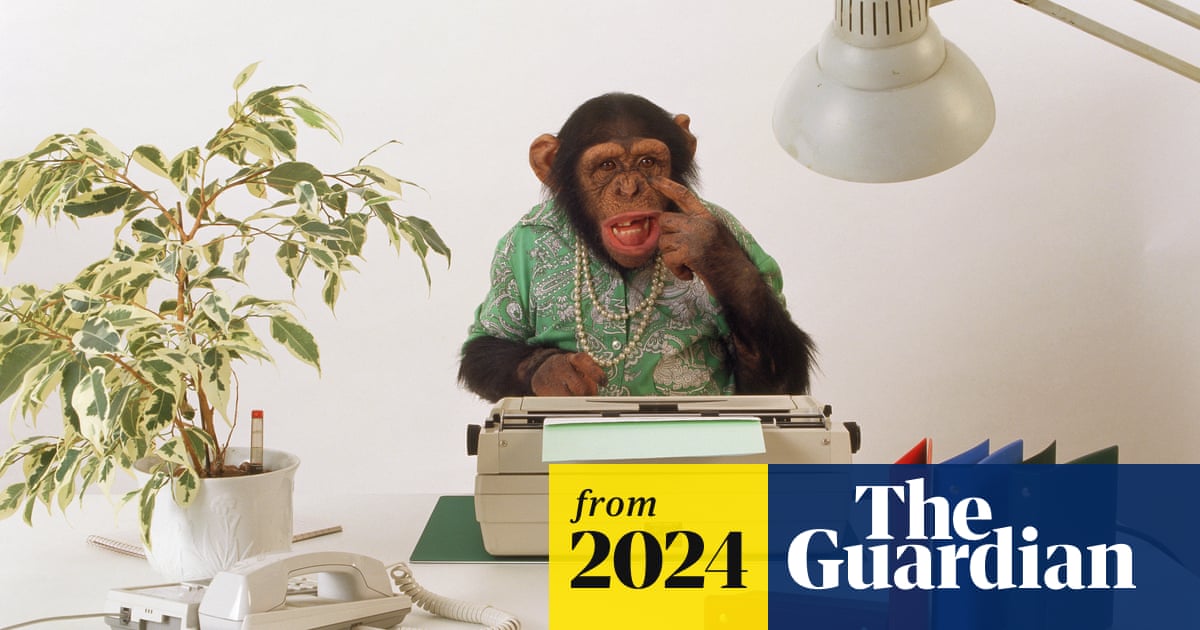
Mathematicians have called into question the old adage that a monkey typing randomly at a keyboard for long enough would eventually produce the complete works of Shakespeare.
Two Australian mathematicians have deemed it misleading, working out that even if all the chimpanzees in the world were given the entire lifespan of the universe, they would “almost certainly” never pen the works of the bard.
The paper tested the “infinite monkey theorem”, a thought experiment demonstrating that an infinite amount of time can make something that is incredibly unlikely become probable, by asking what would happen if generous yet finite limits were placed on the monkey typists.
Their calculations were based on a monkey spending about 30 years typing one key a second at a keyboard with 30 keys – the letters of the English language plus some common punctuation. It found that the time it would take for a typing monkey to replicate Shakespeare’s works would be longer than the lifespan of our universe.
(snipsnap)
Leave a comment:
-
Man barred from hunting 1 year after trying to shoot squirrel, hitting town hall instead
The man was fined $3,000 after striking the town hall in St. Helens, north of Goderich
A man who tried to shoot a squirrel in his Huron County yard and ended up almost striking a person has been barred from hunting for one year and ordered to pay a fine.
The man, from St. Helens, about 30 kilometres north of Goderich, was ordered to pay $3,000 and must complete remedial training before getting another hunting licence, officials from the province's Ministry of Natural Resources wrote in a statement.
The incident happened on June 5 in the township of Ashfield-Colborne-Wawanosh. The bullet ended up hitting the town hall, officials said.
"An investigation completed in conjunction with local OPP determined that [the man] had discharged a .22-calibre rifle at a squirrel in his yard, shooting in the direction of the main intersection of Belfast Road and St. Helens Line. The bullet passed within feet of the township employee before striking the building," officials said.
The man pleaded guilty to careless hunting. The case was heard in the Ontario Court of Justice in Goderich.
Leave a comment:
-
Monkeys will never type Shakespeare, study finds
Two Australian mathematicians have called into question an old adage, that if given an infinite amount of time, a monkey pressing keys on a typewriter would eventually write the complete works of William Shakespeare.
Known as the "infinite monkey theorem", the thought-experiment has long been used to explain the principles of probability and randomness.
However, a new peer-reviewed study led by Sydney-based researchers Stephen Woodcock and Jay Falletta has found that the time it would take for a typing monkey to replicate Shakespeare's plays, sonnets and poems would be longer than the lifespan of our universe.
Which means that while mathematically true, the theorem is "misleading", they say.
As well as looking at the abilities of a single monkey, the study also did a series of calculations based on the current global population of chimpanzees, which is roughly 200,000.
The results indicated that even if every chimp in the world was enlisted and able to type at a pace of one key per second until the end of the universe, they wouldn't even come close to typing out the Bard's works.
There would be a 5% chance that a single chimp would successfully type the word "bananas" in its own lifetime. And the probability of one chimp constructing a random sentence - such as "I chimp, therefore I am" - comes in at one in 10 million billion billion, the research indicates.
“It is not plausible that, even with improved typing speeds or an increase in chimpanzee populations, monkey labour will ever be a viable tool for developing non-trivial written works,” the study says.
The calculations used in the paper are based on the most widely accepted hypothesis for the end of the universe, which is the heat death theory.
Despite its name, the so-called heat death would actually be slow and cold.
In short, it's a scenario in which the universe continues to both expand and cool - while everything within it dies off, decays, and fades away.
“This finding places the theorem among other probability puzzles and paradoxes... where using the idea of infinite resources gives results that don’t match up with what we get when we consider the constraints of our universe,” Associate Prof Woodcock said in a statement about the work.
Leave a comment:
-
Leave a comment:
-
Bat escapes German zoo by hiding in visitor's jacket
By Ben Hooper

A bat escaped from Germany's Karlsruhe Zoo by hiding inside a visitor's jacket. Photo by ntrief/Pixabay.com
Oct. 24 (UPI) -- A bat escaped from a zoo in Germany by landing on a visiting woman and hiding in her clothes until she got home.
Elina Öfele, 30, said she and her young son walked through the bat cave at Karlsruhe Zoo in southwestern Germany last week, and when she got home she removed her jacket and a bat fell to the floor.
Öfele contacted an animal expert and put the bat in a box with honey water and a banana overnight to keep it fed and comfortable.
Her husband and son returned the bat to the zoo the following day.
A spokesman for the zoo said the leaf-nosed bat was returned to its habitat and is doing fine. He said it was the first time a bat had ever escaped from the zoo by stowing away with a visitor.Leave a comment:
-
Paraglider Spots Stray Dog Chilling Atop Great Pyramid of Giza
101824*
A man flying a paramotor over the Giza Pyramid Complex on the outskirts of Cairo spotted a stray dog barking at birds from atop the 138.5-meter-tall Great Pyramid of Giza.
Marshall Mosher, a “pro adventure athlete” who travels around the world, was flying his paramotor over the pyramids of Giza on October 14 when he came across a very peculiar sight – a lone canine chilling on top of the Great Pyramid, seemingly barking at the birds flying overhead. Not exactly the kind of thing you expect to see while flying over one of the Seven Wonders of the World, so it’s no wonder that the clip he posted on his Instagram went viral almost instantly. Some users of the popular social network joked that the pooch must have been the Egyptian God Anubis, while others were worried about its well-being.
Luckily, Mosher followed up his viral video with another clip, this time shot at the foot of the pyramid. It showed both the daredevil canine and a fellow companion, and the human globetrotter explained that there are many stray dogs in the Giza area and they often climb up and down the pyramids, something that we humans are forbidden from doing.
Interestingly, tourists were once allowed to scale the ancient pyramids, but Egypt imposed a ban on the practice and offenders now risk up ti three years behind bars. The same rules apparently don’t apply to dogs…
Leave a comment:
-
A councillor has suggested using birth control as a means of limiting a local gull population.
Councillor Jill Desayrah said the number of gulls near Worcester's Elgar retail park had increased in the last year.
The birds have damaged locals' cars and homes, and disrupted people's sleep by screeching.
Desayrah said the rise in gulls in the area was "partly due" to their displacement from the city centre, where they had previously been a problem.
In July, a hawk was flown around Worcester city centre in an attempt to get the gulls to move on.
"I'm glad to see the city centre is more free of them, that's a good thing for everybody, but it's not good to see so many of them appear to be displaced here," she said.

Leave a comment:
- The Altera Centauri collection has been brought up to date by Darsnan. It comprises every decent scenario he's been able to find anywhere on the web, going back over 20 years.
https://apolyton.net/forum/other-gam...rio-repository -Check it out, and enjoy some excellent Alpha Centauri/Alien Crossfire action. - 25 themes/skins/styles are now available to members. Check the select drop-down at the bottom-left of each page.
- Call To Power 2 Cradle 3+ mod in progress: https://apolyton.net/forum/other-games/call-to-power-2/ctp2-creation/9437883-making-cradle-3-fully-compatible-with-the-apolyton-edition






Leave a comment: