
Homoeroticism
Some modern scholars and writers have interpreted the love between David and Jonathan as more intimate than platonic friendship. This was first pioneered by Horner, then rehearsed by Boswell and Halperin.[24][25] This interpretation views the bonds the men shared as romantic love, regardless of whether or not the relationship was physically consummated. Jonathan and David cared deeply about each other in a way that was arguably more tender and intimate than a platonic friendship.
David's praise in 2 Samuel 1:26 for Jonathan's 'love' (for him) over the 'love' of women is considered evidence for same-sex attraction, along with Saul's exclamation to his son at the dinner table, "I know you have chosen the son of Jesse - which is a disgrace to yourself and the nakedness of your mother!" The "choosing" (bahar) may indicate a permanent choice and firm relationship, and the mention of "nakedness" (erwa) could be interpreted to convey a negative sexual nuance, giving the impression that Saul saw something indecent in Jonathan's and David's relationship.[26]
Some also point out that the relationship between the two men is addressed with the same words and emphasis as other love relationships in the Hebrew Testament, whether heterosexual or between God and people: e.g. 'ahava' or אהבה.[27][28][29][30][31][32][33][34]
When they are alone together, David confides that he has "found grace in Jonathan's eyes", a phrase proponents say normally refers to romantic or physical attraction. Throughout the passages, David and Jonathan consistently affirm and reaffirm their love and devotion to each other, and Jonathan is willing to betray his father, family, wealth, and traditions for David.
That there is more than mere homosociality in the dealings of David and Jonathan is asserted by two recent studies: the Biblical scholar Susan Ackerman,[35] and the Orientalist Jean-Fabrice Nardelli.[36] Ackerman and Nardelli argue that the narrators of the books of Samuel encrypted same-sex allusions in the texts where David and Jonathan interact so as to insinuate that the two heroes were lovers. Ackerman explains this as a case of liminal, viz. transitory, homosexuality, deployed by the redactors as a textual means to assert David's rights against Jonathan's: the latter willingly alienated his princely status by bowing down, sexually speaking, to the former. Nardelli disagrees and argues that the various covenants Jonathan engaged David into as the superior partner gradually elevated David's status and may be seen as marriage-like.
Susan Ackerman also believes that there is highly eroticized language present in six different sections in the Hebrew Bible in regards to the relationship of David and Jonathan.[37] The six sections she mentions are 1) David and Jonathan's first meeting in 1 Sam. 18:1-18:4 2) the most important description of David and Jonathan's first few meetings in 1 Sam 19:1-19:7. 3) the incident of Saul berating Jonathan for his friendship with David in 1 Sam 20:30-20:34 4) David fleeing from the court of King Saul in 1 Sam. 20:1-20:42 5) the description of David and Jonathan's final meeting in 1 Sam. 23:15-23:18 and 6) David's lament (the Song of the Bow) for Saul and Jonathan. Of these six examples, Ackerman identifies the most important example being the last one (the Song of the Bow) due to David's assertion that Jonathan's love to David "was more wonderful than the love of women".[38]
Although David was married, David himself articulates a distinction between his relationship with Jonathan and the bonds he shares with women. David is married to many women, one of whom is Jonathan's sister Michal, but the Bible does not mention David loving Michal (though it is stated that Michal loves David).
Counter-arguments
Traditional religious apologists point out that neither the books of Samuel nor Jewish tradition documents sanctioned romantic or erotic physical intimacy between the two characters, which the Bible elsewhere makes evident when between heterosexuals, most supremely in the Song of Solomon. It is also known that covenants were common, and that the word is never used to denote marriage between man and women,[39] and that marriage was a public event and included customs not seen in this story.[40][41]
The platonic interpretation of David and Jonathan's relationship is seen as being advocated by some Christian writers particularly for theological and methodological reasons. Two modern advocates named are Robert A. J. Gagnon,[42] and the Assyriologist Markus Zehnder,[43] and as such is consistent with commonly held theological views condemning same sex relations.[44]
Those who hold to this position on David and Jonathan may work from the theological foundation of Biblical infallibility and a more literalistic approach to exegesis, so that while interpretations are understood within the context of their particular literary genres, a wide range of metaphorical meanings of the historical narratives, in particular, are disallowed.[45][46][47][48] The disrobing aspect is seen as partial (especially in the Hebrew), that of his robe and outer garments, his sword, bow and “girdle," which denotes part of a soldiers armor in 2Samuel 20:8 and 2Kings 3:21. In addition, this action is evidenced as having a clear ceremonial precedent under Moses, in which God commanded, "And strip Aaron of his garments, and put them upon Eleazar his son",[49] in transference of the office of the former upon the latter. In like manner, Jonathan would be symbolically and prophetically transferring the kingship of himself (as the normal heir) to David, which would come to pass.[50][51][52]
Even if the mention of "nakedness" in 1 Samuel 20:30 could be interpreted to convey a negative sexual nuance, this could be referring to Ahinoam rather than Jonathan. Jon Levenson and Baruch Halpern suggest that the phrase suggests "David's theft of Saul's wife", and that the verse supports the construction that Ahinoam, the wife of Saul is the same Ahinoam who became David's wife.[53]
In platonic respects, such as in sacrificial loyalty and zeal for the kingdom, Jonathan's love is seen as surpassing that of romantic or erotic affection,[54] especially that of the women David had known up until that time. The grammatical and social difficulties are pointed out in respect to 1 Samuel 18:21,[55] as well as the marked difference in the Bible between sensual kissing (as in Song of Songs) and the cultural kiss of Near Eastern culture whether in greeting or as expression of deep affection between friends and family (as found throughout the Old and New Testaments).[56] The strong emotive language expressed by David towards Jonathan is also argued to be akin to that of platonic expressions in more expressive or pre-urban cultures.[57]
There! Instead of you ****ing taking quotes, bolding lines, and being like "yeah. Seems pretty gay, right?" to what end I have no idea... there, there's a bunch of stuff people have said about it being gay and a bunch of stuff in response to that.
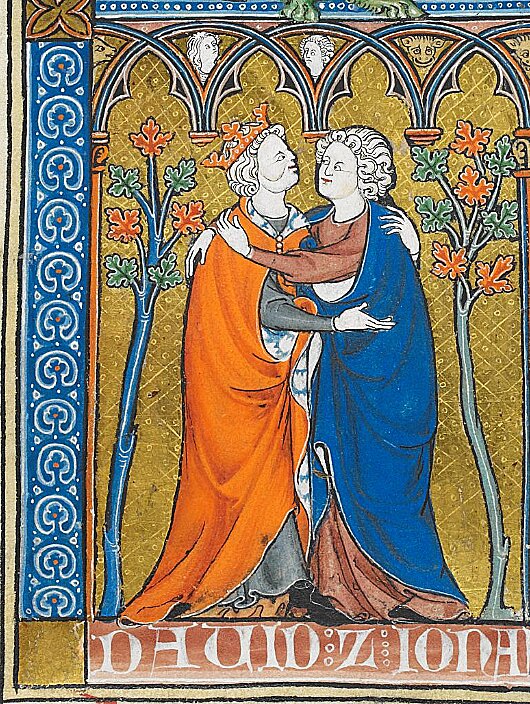
David and Jonathan in embrace, "La Somme le Roy", 1290 AD; French illuminated ms (detail); British Museum


Leave a comment: