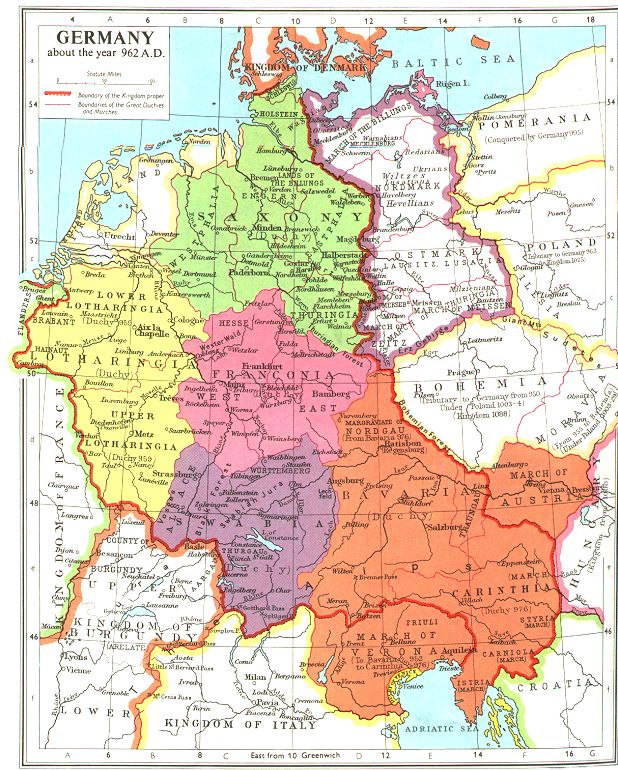
And I don't have a map, but this is a good one from about 50 years later:
![]()

I suppose that it might help this forum to have something going on at all times - so, I submit to you what I've been working on as an exercise. A small taste:
HRE NES: The Birth of an Empire
It is the Year of Our Lord 911. Charlemagne, Holy Roman Emperor and King of the Franks, has been dead for nearly a century, and his empire is a shadow of its former self. The Christians of Europe are split into petty kingdoms and duchies, and Charlemagne's crown sits in a Papal vault in Rome - its last wearer, Louis of Burgundy, was humiliated in an abortive invasion of northern Italy, and had his eyes put out by the master of Friuli, Berengar. Berengar has assumed the title of Emperor, though the Pope has yet to officially recognize this, and he is yet uncrowned.
The Throne of Saint Peter is also not what it once was. The current Pope (as was his predecessor, Sergius III) is deep in the sway of several powerful Roman families - more precisely, he is in the sway of powerful women within those families, and the illicit affairs that are rumored to go on in the holiest parts of the Eternal City have become the source of many derisive jokes and ribald rhymes. For now, these powerful families control the Papacy, and use it chiefly for their own immediate gain in the environs of Rome.
Not all is decaying, however. In the dark forests of Germany at the edges of Charlemagne's empire, new powers are emerging. The tribes of the Germanic peoples have only recently restyled themselves as feudal nobility, and have appropriated large and independent realms for themselves. The four most powerful of these German Dukes, rulers of the tribal regions known as the 'Stem Duchies,' have banded together this year and elected the first true King of Germany (or East Franconia, as it is more properly known), Duke Conrad of Franconia. Threatened by the ruthless Magyar horsemen from the southeast, the Dukes have - at least superficially - submitted to a Monarch. Make no mistake, however, that they will humbly accept vassaldom and servile obedience to their new King � it was not long ago that their ancestors were pagan chieftains plundering the ruins of the Roman Empire, and they thirst for the power and wealth that could be theirs as Duke, King - or Emperor.
--------------
What follows is a far-too-long doc that mostly consists of me writing about this NES instead of doing homework. Please enjoy; If we can attract a good 4 players here, I will certainly consider starting the NES for real, but for now I'd just like your comments.
--------------
Last edited by Cyclotron; November 28, 2005 at 16:26.
Lime roots and treachery!
"Eventually you're left with a bunch of unmemorable posters like Cyclotron, pretending that they actually know anything about who they're debating pointless crap with." - Drake Tungsten

And I don't have a map, but this is a good one from about 50 years later:
![]()
Lime roots and treachery!
"Eventually you're left with a bunch of unmemorable posters like Cyclotron, pretending that they actually know anything about who they're debating pointless crap with." - Drake Tungsten

Can't download the doc-- I don't think it's a legal attachment type
Those walls are absent of glory as they always have been. The people of tents will inherit this land.

How odd, I can see it fine - but I think you're right, it's illegal. Fair enough, I can post it piecemeal.
Lime roots and treachery!
"Eventually you're left with a bunch of unmemorable posters like Cyclotron, pretending that they actually know anything about who they're debating pointless crap with." - Drake Tungsten

Playable Factions and Leaders:
Duchy of Franconia - King Conrad I
Duchy of Bavaria - Duke Arnulf "the Bad"
Duchy of Swabia - Duke Burchard
Duchy of Saxony - Duke Otto "the Illustrious"
Unplayable Powers:
Kingdom of Lotharingia - King Rainier of Mons
Kingdom of Italy - "Emperor" Berengar of Friuli (uncrowned)
Kingdom of Upper Burgundy - King Rudolph
Kingdom of Lower Burgundy - King Louis III "the Blind"
Kingdom of Western Francia - King Charles III "the Simple"
Duchy of Normandy - Duke Rollo Ganger (fealty owed to Charles III of Francia)
Republic of Venice - Doge Pietro Tribuno
Magyar Horde - Fejedelem Szabolcs
Kievan Rus - Prince Oleg
Papal States - Pope Anastasius III
Kingdom of England - King Edward "the Elder"
Eastern Roman Empire - Emperor Leo VI "the Wise"
Croatian Duchy of Dalmatia - Duke Tomislav
Emirate of Cordoba - Emir Abdallah ibn Muhammad
Last edited by Cyclotron; November 28, 2005 at 16:28.
Lime roots and treachery!
"Eventually you're left with a bunch of unmemorable posters like Cyclotron, pretending that they actually know anything about who they're debating pointless crap with." - Drake Tungsten

Strategy Guide
Or, Dukedom for Dummies
I. Basics
Who am I?
You’re a Duke of one of the four Duchies of East Franconia: Franconia (not to be confused with the Kingdoms of East and West Franconia), Saxony, Swabia, or Bavaria. Your immediate predecessors were tribal military leaders who came to power promising to protect your people from the savage Magyars, and now you are an independent ruler of your territory. Your sovereignty, however, is incomplete; you are not an absolute monarch. This is the most important lesson to learn – act too much like one and your family inheritance will vanish.
Can I play somebody else?
No. The NES has been designed for the Stem Duchies to be the only playable factions. All the other kingdoms and nations are controlled by the referee.
That said, events during the course of the NES may produce new Duchies under the control of the East Franconian King; the referee will announce on the original post any new openings for other players.
What can I do?
As Duke, you have four factors limiting your authority: The Church, the King, the Emperor, and your Vassals.
The Church has the sympathies of your religious subjects, and has numerous agents within your realm. The Pope or other lesser Christian leaders can call for action to be taken against you if you run afoul of the faith, and the clergy within your borders can incite your people to revolt. Worst of all, the Pope can excommunicate you – which formally dissolves all bonds of loyalty between your vassals and you, a feudal lord’s worst nightmare. The clergy in your Duchy control a considerable amount of land and resources, and their cooperation is important to your efforts. Generally, clergy in your land tend to be sympathetic to you, and may even side with you against the Pope if a crisis occurs.
The King of East Franconia is nominally your sovereign, and you disobey him at your peril. While his actual rights over you are quite limited, he can use his prestige and support among the other Dukes and foreign powers to either help or hinder you, depending on how good a vassal you are. The King also has the power to appoint new clergy within your lands, and thus the religious element in your Duchy is likely to support the King against your interests if matters come to a head.
The Emperor is the theoretical head of all Christendom. While the Emperor may have no formal rights over you if he is a foreigner, his office still commands enormous prestige, and he is often an ally of the Pope – if the Pope is not already his puppet! If the Emperor happens to be your King as well, you had best think carefully before facing him, as he will have considerable resources, allies, and church support at his command.
Finally, your realm is largely composed of feudal fiefs run by hereditary vassals. Taxes, at this point, don’t exist – the French monarchs can get away with it sometimes, but the concept has yet to be introduced to Germany. Instead, you only receive profits from the lands you personally own. Your vassals, in exchange for the land they occupy and exploit, give you their loyalty and provide you with military service. The Barons and Counts that make up your realm are proud and often greedy, and don’t take kindly to the expansion of your power at the expense of theirs. If presented half a chance, your nobles may rise up against you if you abuse them too much.
How do I give orders?
Orders fall into one of two categories: public or secret. You are encouraged to make as many things public as you are able, as it makes the NES more entertaining for everyone. Some matters, like military movements, orders of battle, secret diplomacy, and espionage work, should be given to the referee (Cyclotron) by a PM. Orders must be in by the deadline set by the ref. Not giving orders may prompt your nobles – or even your own family members – to dispose of you and take your Duchy for themselves.
All orders must include a “balance sheet” detailing how you are spending your money; this must be a public order. You can exclude expenditures that are to be spent secretly, provided that the amounts are clearly specified in your secret orders PMed to the referee. This will be explained more fully in the next chapter.
More description is always positive. The more you describe, the more successful you are going to be. This applies to building orders and diplomatic negotiations as much as it does to military orders. Don’t go too overboard, for the sake of the referee, but do explain and describe everything as well as you can – make a few stories about it, or write in first person, or anything else to make this NES better.
It’s important to note here that orders are encouraged to be as free-form as possible. That is, your imagination is the limit – the ref will allow and mod any proposal of yours that could realistically be implemented. Be creative!
Hey, this NES isn’t historically accurate!
I have tried to make this NES as accurate as possible, but I have sacrificed some elements for gameplay reasons. If you see a major error, go ahead and point it out to me by PM, but be warned that I may have already considered it and decided to do something different.
My philosophy on these scenarios is that history ends as soon as the NES begins. Some historical events will happen on time, others will happen differently from how or when they happened in real life, and some won’t happen at all. Don’t be confused if the NES starts veering away from the history books – we’re here to rewrite history.
What is the goal of this NES?
This isn’t a very goal oriented NES; it is not assumed that the German tribes will conquer the world. Cooperation with other Duchies and powers is important. It would be quite an achievement to have your Duke crowned King and Emperor, with his personal Pope in Rome, Northern Italy firmly in the grasp of the Empire, the Magyars and Vikings subdued, and the pagan Slavs retreating before the growing eastern frontier of the new Holy Roman Empire. Of course, there are other ways to gauge success as well – it’s up to you to define the goals of your dynasty.
Lime roots and treachery!
"Eventually you're left with a bunch of unmemorable posters like Cyclotron, pretending that they actually know anything about who they're debating pointless crap with." - Drake Tungsten

II. Economy
How rich am I?
Every Duke wants and needs resources, and in this NES those resources largely take the form of silver denarii, the coins originally minted by Charlemagne for his great empire. Denarii are used in this NES as an indicator of wealth; this does not mean that you actually have that many silver coins lying around. Your wealth is tied up in various properties, rights, goods, livestock, and precious metals, with coins only rounding out the collection – but for ease of use this has all been simplified to denarii. Denarii can be used for almost anything – raising an army, bribing a foreign leader, paying off barbarian raiders, or any other use you can think of.
How do I get denarii?
Because the Germans don’t have any concept of taxes at the start of the game, your major source of income is through what is known as the “Ducal Demesne.” This, quite simply, is the land within your Duchy that you personally control, and is not given out to any of your vassals. Your income depends on how valuable the Ducal Demesne is. Mines, farms, forests, and ports within your demesne all churn out income.
Your demesne can be made more profitable in two ways: it can get bigger, or it can get more valuable. It’s very easy to simply seize the territory of your vassals to increase your demesne – and thus your profits – but this violates the code of feudalism, and you are likely to end up with a full-scale rebellion on your hands. Even if no rebellion occurs, stealing land from your vassals will drastically reduce their loyalty to you. You may legally repossess a fief of a rebellious or disloyal vassal, but you may anger his rightful heirs by doing so. The Church also has properties within your Duchy, and it can be tempting to appropriate their lands, but this is equally dangerous. Many churchmen are also your vassals – at this point, there is little difference between a bishop and a baron save in their choice of clothing. Other church holdings may not be fiefs, but taking church lands will not endear you to the Papacy, and may put you at odds with your King, who is viewed as the protector of the clergy in the kingdom and is a nominal ally of the Pope. This doesn’t mean you can’t appropriate land and add it to your demesne – it just means that you should be prepared to deal with the consequences of such an action.
You can also increase your income by improving your demesne. You can search for veins of ore, build mines, and expand them. You can cut down forests in your demesne and encourage freemen to farm there. If there are trade valuables within your demesne, you can trade them with other rulers and make a healthy profit. This takes an initial investment on your part; the greater your investment, the greater the returns, generally speaking.
It is also possible to add to your demesne through conquest – but not always wise. Technically, your Duchy is a fixed entity. While the Pope may appreciate you taking land from the pagans to the east, your fellow Dukes will not be keen on you gaining excess revenue and power. The King may demand that you give this land up to the Kingdom, so that he may decide how to apportion it; it is within his feudal right to do so, though he may not have the power to exercise that right. He probably won’t bother with it if you take only a little, but that depends on the King. It becomes much easier to hold conquered land – both from its original rulers and your fellow Dukes – if you carve it up into landed fiefs for your nobles, but this reduces the amount of land available for your demesne, and thus the profits you gain from it. If you conquer too much and are not strong enough to hold it from your King and fellow dukes, the King may declare it a new Duchy and appoint a new Duke to administer it. This can be profitable if you can intimidate the Duchy into being your virtual client state, but beware of abused Dukes suddenly growing a backbone!
All your territories are assigned percentage numbers that indicates how much of the land is “enfeoffed” (that is, given over to your vassals in fiefs), how much is possessed by the Church, and how much is your Ducal Demesne. This number goes up and down depending on your actions, as described above. You can separate your Duchy into different administrative districts, and change their percentages separately. Conquered territories are automatically made into a new administrative district.
At some point it may occur to you to levy taxes. Taxes at this point in time are levied only for specific military campaigns or purposes, and only by France and England. The first realm-wide tax in England, in fact, was the Danegeld, which was for the sole purpose of paying off Viking raiders. Introducing taxes to your people and nobles will not be welcomed, but it may become necessary. These are fixed taxes; you can declare that you are collecting X amount of Denarii, and who you are collecting it from. On the one hand, your vassals may understand the need for the tax and acquiesce, but if they think you are taking too much for too little of a reason they may resist or refuse. You can always negotiate with your nobles to find out what they will accept – you can certainly demand more, but you should be prepared to enforce your tax collections with the sword (or other means, open to your imagination).
Finally, there are many other unorthodox ways to rake in the denarii. Plunder is an important one; you will get denarii whenever you defeat an enemy army or conquer enemy territory. You can tell your troops and generals to extract more or less plunder; if you intend to keep the territory, it is generally advisable not to rob the inhabitants blind. You can extract denarii from other leaders or peoples in the form of tribute, or in exchange for some service or alliance. After a battle, you can ransom back prisoners to the enemy for denarii, or hold enemy nobles or generals hostage unless ransom money is forthcoming. The possibilities are quite numerous.
How do I lose denarii?
Unfortunately, it’s much easier to lose than to gain. Your expenditures must be carefully managed lest they get out of hand and make you a pauper.
Your biggest expenditure is likely going to be your military. Your vassals are the cheapest of your units; their service is part of the terms of their enfeoffment, and they pay for their own equipment. They will usually pillage the countryside for food when on campaign, but when in wasteland areas they require a stipend on your part to support them. Feudal levies, from the classes of freemen, are more expensive – they do not have to be paid either, as you’re forcing them to serve, but they must be equipped at your expense. They also need more money when garrisoned or in areas without food to plunder. Finally, mercenaries need money upfront, but after that are generally content to take a large share of the plunder on a campaign. When plunder is scarce, or if they are garrisoned, they will demand more money, and can become quite expensive.
You also will lose money through raiding. Minor raids are abstracted in this NES; most raids will not appear as an army moving into your territory. Rather, they will subtract a certain amount of denarii each turn, depending on how severe the raids are and how powerful the raiders are. You can decrease this loss by building and garrisoning fortresses on the frontier, paying off the raiders, taking an army into their lands and cleaning house, or though other diplomatic or military means. Raiding, however, is unlikely to ever cease entirely, and you will have to get used to losing a little to the pagan hordes – this is the Dark Ages, after all.
You will also lose money through corruption. Workers steal from mines, your less dependable vassals steal from you, local bandits make petty raids on your enterprises, and peasants may pocket a little here and there to make their lives slightly more bearable. This factor is impossible to eliminate, but may get better or worse depending on events. An unpopular or weak ruler will suffer much more in this category than a popular or strong one.
Can I stockpile denarii?
Of course, and it is recommended that you do so. A large treasury in reserve is vital when it comes time to go to war. Never underestimate the value of saving.
Can I use deficit spending?
No. If your expenses take your treasury to a number below 0, you are unable to pay your military and/or creditors. Unless you come up with the money quickly, your soldiers will disband or rebel, and your foreign creditors may come knocking with armies behind them. You cannot submit a balance sheet for the turn that would have you lose more denarii than you currently have in your treasury.
Lime roots and treachery!
"Eventually you're left with a bunch of unmemorable posters like Cyclotron, pretending that they actually know anything about who they're debating pointless crap with." - Drake Tungsten

III. Military
How do I attack?
Just include it in your orders, either public or secret. Tell the referee all the details about your attack. It�s not necessary to declare war first, and most rulers don�t bother with that anyway - this is the Dark Ages, and war isn't a polite business.
How should I write my orders?
It doesn't matter how, but it would help to include the following:
- What troops you are using
- What the target is
- What route you are taking from the starting point to the target
- Whether you intend to occupy or simply raid the target
- What your tactical plans for battle are, should you engage the enemy
- How much your troops are allowed to sack and pillage the target
- Which general you are using
- Anything else you think is important
What's this about generals?
Whenever you raise an army, a general is automatically provided. Generals are typically nobles from one of your prominent fiefs. They are given a random name and put at the front of your army.
Generals are people, and they can be very different people. Whenever a general is created, the referee gives him a few random attributes; these quantify how loyal he is, how competent he is in battle, how charismatic he is, how aggressive or defensive he is, how brave or cowardly he is, and so forth. There is no way for the player to know these things about a general except by the way the general behaves in battle.
Generals can be relieved of command or killed in battle, and a new general will be randomly generated for the army. Relieving a general doesn't usually cause problems, though some may be offended, and less loyal ones might even start swaying towards your enemies.
When engaged in battle, a general will attempt to carry out your tactical orders to the best of his ability. If the situation changes so that your orders don�t make sense, no longer apply, or are obviously suicidal, he will choose his own course of action that he feels is most in line with the intent of your orders. Sometimes a general may ignore your commands, especially if he is very headstrong or a spineless coward. Usually, however, generals want to remain in favor with their lord, and will follow orders unless the situation is untenable.
Generals may be more or less susceptible to bribery and other interference depending on how loyal they are; you can try and increase the loyalty of your generals by giving them command of more men or increasing their estates. Being King or Emperor also increases the loyalty of all your generals.
You may also lead an army in person. For very important campaigns, this is preferable, and leading successful campaigns in person hightens your prestige and influence. It eliminates the chance of your army being bought off or disobeying your orders, and increases the morale of the army, but should you be killed in battle your inheritance may not be assured. Losing a Duke is very dangerous for a young Duchy.
How do I get troops?
There are three kinds of troops that can be raised.
Your vassals. These are the major and minor nobles that you have enfeoffed in your lands. As part of the terms of their vassaldom, they must provide you with military service. Your vassals are generally quite wealthy, and can buy themselves the best of equipment. They have vassals of their own, usually a handful of knights and sergeants, that take to the field with them. They are excellent troops, with high morale, quality equipment, and plenty of training. They are also quite cheap, because they do not need to be paid for their service. The drawbacks of vassals are that they are available in only a limited quantity, and they tend to be hotheaded in battle - they are keen for glory and plunder and may disobey your orders if they think they can get it quickly. Additionally, vassals are only bound to serve for one campaign at a time; they can't be used to garrison fortresses, unless they are given the environs of the fortress as a fief. The more territory you have given over to fiefs, the more vassals you have at your disposal.
Freedmen levies. These freedmen are non-noble landholders, members of the middle class, artisans, workmen, and free farmers that are called up into your service. Despite the fact that they are conscripted, many feel a certain amount of patriotism for their tribal Duchy and do not necessarily have low morale. They are not rich enough to buy their own battle equipment, and this must be purchased for them. They must be given a stipend suitable to support them and their families while they are away. They also lack the experience and training of the nobles. For all this, they are still important in any army, as they can be called up in much larger numbers than the vassals. They can also be used to garrison fortresses and cities, and as a workforce to build forts, bridges, and the like. Freedmen are not impetuous like vassal warriors are, and are more likely to follow your general's commands. Because horses are expensive and most freedmen lack riding skills, freedmen levies are always infantry. At some point, however, you may come into control of lands with inhabitants more accustomed to life in the saddle, and this may change.
Mercenaries. These are troops that you hire with an initial payment of money, who serve you during a campaign as long as they have a prospect of plunder. Mercenaries come in all types - swift Magyar horsemen, fearsome Danish Vikings, vicious Slav warriors, Lombard adventurers, Sicilian Muslim soldiers, or any other group of people that are looking to sell their services. They have their own equipment that varies depending on their origin, but require much more money than other troop types, typically collected from the plunder of enemy armies and towns. If plunder is not forthcoming, or if they are hired to garrison a town or fortress, they must be paid with more ready cash. They may or may not be as headstrong as vassals, depending on their type. Their loyalty is not very good, and may be bought off if the enemy can promise more money than their current employer. They are experienced warriors and can even outfight vassals if their equipment is good enough (and numbers are on their side), though their morale is generally not quite as high as that of vassal warriors. Mercenaries are expensive, but rulers often build up a treasury for the specific purpose of hiring them, as they are extremely useful on a campaign.
Some troops may occasionally come from other sources. That will be fully explained when it happens.
How are troops outfitted?
The only troop type that requires you to buy equipment is freedmen levies, but since they make up the bulk of most armies this is an important consideration.
Weapons come in several broad categories. You can give them specific descriptions if you wish, though it won't change game dynamics. All weapons are considered to cost the same, though giving troops multiple weapons increases the cost quite a bit.
Sword: This includes all manner of one-handed blades, but it mainly refers to the roman-style spatha. It is the typical one-handed melee weapon, doing good damage against light troops but less effective against armored opponents.
Axe: This includes all one-handed axes. Though not as effective generally as a sword, the axe performs better against armor.
Spear: The spear performs decently against light troops, comparable to the axe, but is much more effective against cavalry rather than armor.
Polearm: This includes poleaxes, guisarmes, Danish axes, and other early types of two-handed pole weapons or really big axes (halberds and the like are several centuries away). Polearms are much like axes in terms of effectiveness, but also gain the anti-cavalry bonus of the spear, though the wielder sacrifices a shield for this. Against enemies both armored and on horseback, it is among the most powerful weapons.
Javelin: This includes all manner of throwing spears, including the Frankish Angon, a derivative of the Roman pilum, but also generally includes other throwing weapons like throwing axes and war darts. They are effective against light troops, and also are moderately effective against armor.
Bow: The bow is not quite as effective generally as the javelin and lacks the same effectiveness against armor, but has a much longer range. Bowmen can also carry many more arrows than javelineers have javelins.
Armor comes in three types: Cloth, Light, and Heavy. Cloth armor is simply a padded shirt, a thick tunic, or some other very basic protective gear. Light armor is padded armor reinforced with metal studs, ring mail, or a crude chain shirt. Heavy armor is a full chain hauberk that covers nearly the entire body (it's 911, no plate mail yet). Heavy armor is much (almost exponentially) more expensive, and slows down the wearer, but is much better at protecting the wearer.
Shields can also be added to units using one-handed weapons. They increase the unit's defense, especially against missile weapons, and are not considered armor for the purposes of armor-piercing weapons (axes, etc.).
Pavises are very large shields that are used to protect archers. They are useless in melee, are slow to carry about, and must be left behind if a unit flees the field. That said, a unit with a pavise is almost invulnerable to missile fire, making them very valuable in sieges and ranged duels.
Vassals are generally considered to be armed with a sword and a lance (like a spear, but additional damage in a charge), and protected with heavy armor and a shield. Their knights are similarly armed. Sergeants, the lowest rung on the feudal ladder brought by your vassals, are armed the same way but typically only have light armor. Some vassals may equip their troops differently than others.
Gear, either weapons or armor, can be crafted during your turn - just specify what you want to produce in your orders. More or less gear will be produced depending on the various factors, including the availability of iron and the quality of smiths in your realm. Unused gear is stored in the armory; it can be traded or sold to other Dukes or foreign leaders. When you defeat an enemy army, part of the plunder will be in the form of arms and armor; this can be used to outfit your victorious army or simply added to your armory.
How do I order troop building?
For vassals, all you must do is issue a call to your vassals in an order. Specify how many you want, and where they should assemble. Unless your vassals are very disloyal or rebellious for some reason, they will assemble as told, ready for combat, at the specified point.
For freedmen, you must call up a levy in an order. Specify how many you want and where they should assemble. You'll be assessed a fee for organizing the levy and providing rudimentary training. Then, you may equip the levies with gear from your armory. It takes two turns to call up a levy, one for calling them up and one for training. There is a limit to how many you can call up at once that depends on the size of your realm. Conscription may also be helped by other factors that you might think of.
For mercenaries, inquire with the referee as to what is available. You can choose how many of a mercenary type you want, though there are of course limits as to how many are available. Specify where you want them to assemble; it takes one turn.
Can I lay siege to castles?
Yes, and you'll probably have to do so at some point. Storming and reducing enemy keeps is the best way of subduing a foe � without proper defense, he won�t be able to hold his land. Raiding and lawlessness will take their toll on his profits, and he will be unable to stop future armies of yours from entering and plundering at will.
When you move into a siege position around a fortress or fortified town, your troops will surround the position and circumvallate the city - this means that they build earthworks and palisades to protect themselves from sorties by the defenders. Once the city is completely encircled and blockaded, the countdown to its surrender begins - the defenders only have so much food. Over time, starvation and disease take their toll of the defenders, until they are finally forced to surrender.
This process, however, takes many years, and during that time the enemy could bring up a relieving army, or disease could start taking a toll on the emcamped attackers as well. Thus, many commanders try to expedite the process, and there are several ways to do so. These are some general ideas for siege warfare - you are welcome and encouraged to come up with other methods and describe specifically how you want a siege conducted.
The commander may order an escalade. This is used principally against stone fortifications. The attackers use the local wood available to build scaling ladders and siege towers, and attempt to take the walls by storm. This is the fastest way to take a castle, but the defenders have a tremendous advantage - it is typically only successful if the defenders are heavily outnumbered or very demoralized. If the garrison is too small to hold the entire wall, an escalade on multiple fronts can quickly produce victory.
The commander may order a breach. In the case of wooden fortifications, this involves piling flammables against the wall or gate and setting them on fire. This takes very little time, though the attackers will be vulnerable to enemy archers and sorties. If they are supported by a strong contingent of archers, the attackers will have a better time with the attack. For stone castles, making a breach requires siege weaponry, in the form of catapults or ballistae. It takes time to build this siege weaponry on the field, but once constructed the walls are unlikely to last long - the defenders' only hope is to sally forth and destroy the engines in a sortie. Once breached, your men pour through the walls and storm the fort.
The commander may order mining. This takes the longest of any siege method, and is somewhat of a gamble � but if it succeeds, the castle is surely doomed. Sappers dig tunnels under a (stone) wall, and support it with wooden beams. Then, when the tunnel is complete, they fill it with flammables and set it on fire, destroying the beams and causing the tunnel and wall to collapse. Your siege engineers may miscalculate, however, and the wall may be untouched or only damaged. Sapping is also impossible for the enemy to stop except through a sortie.
The commander can, of course, order all these things to be done together. Very involved sieges typically use all these techniques to bring down a castle. Commanders have a separate rating for their skill with siege warfare, and this may improve as they conduct more sieges. Some people of different lands are also better at sieges than others; Byzantine commanders are far more capable of conducting siege warfare than the nomadic Magyars. Even a comprehensive siege, however, may take several turns to complete.
Once a fortress is taken, you can either choose to repair it or reduce (raze) it. Either option is instantaneous; just say what you want done with the fortifications in your orders.
There is still another way to take a castle - through subterfuge. Bribes and threats can be far more effective than the mightiest catapult, and are far less likely to cause casualties on your side. It's certainly something to think about.
How do I build fortifications?
Fortifications are abstracted in this NES. You choose a border with another people or country, and declare that you are fortifying the border. You begin building a network of fortresses there immediately. Each type of fortification is different, and some are much more expensive than others.
Wooden forts are the cheapest and easiest to construct. They are of an early motte-and-bailey construction, featuring a large mound of earth (the motte) surrounded by a dry moat (basically a ditch). Atop the motte is the bailey, a courtyard enclosed with a sturdy circular wooden palisade. Inside the bailey is a small wooden tower/keep, wooden barracks and stables, storehouses, and usually a well. Wooden forts are very cost effective for keeping disorganized raiders out, because most barbarian raiders typically lack the discipline or patience to attack a fort. The network of forts provides advance warning to the interior of your land, and helps coordinate defense against attackers. A determined an organized enemy, however, can reduce wooden fortifications quickly with fire. They are very quick to build.
Tower Houses are the next stage of fortification. They have a similar motte-and-bailey construction, but their palisade walls are thicker, higher, and feature small stone and wooden towers at regular intervals that aid in the defense of the wall. Instead of a wooden tower at the center, they have a larger square keep made of stone. Though significantly more expensive to build, tower houses are even better (though perhaps not as cost effective) at keeping the rabble out, and force enemies to spend time laying siege before they are taken. Though it is unlikely they will stop an organized invasion, they will certainly slow it down, allowing the defenders to gather a counterattack.
Stone Keeps are the best, and most expensive, type of fortification. They feature an even larger square stone keep, perched atop a motte. The motte itself is surrounded by a sturdy stone ring wall, with a moat around it. Streams nearby are diverted to fill the moat. Stone keeps are very expensive and take some time to construct, but they are serious hindrances to large invasions. An invading army will be forced to lay siege to each keep in an area individually, and may even be unsuccessful in taking them if the keeps are well garrisoned. They are not really any better at stopping disorganized raiding than a tower house, and only marginally better at that than a wooden fort.
Towns and cities can also be fortified, in a similar manner (either with a wooden palisade or a stone ring wall). Typically, town fortifications are much more sturdy and expansive than fortresses, though they also cost more. Both building walls around towns and building fortresses contribute to lowering corruption in your territory.
All fortresses, of course, are only as useful as their garrisons. Fortresses with no people in them are useless. You can declare how many troops are to be garrisoned on each border; more troops mean better protection against raids and attacks. The longer the border is, the more troops are necessary to secure it. A border cannot be manned unless some kind of fortress network exists there. A large border force is always helpful, but stronger fortifications will greatly magnify the effectiveness of the force. A border that is dangerously undermanned will not be valuable even if the fortifications are heavy - under-strength stone keeps fall quickly to escalades.
Towns can be garrisoned even if they have no fortifications. Garrisons in towns contribute to civil order and help lower corruption.
Last edited by Cyclotron; November 28, 2005 at 16:25.
Lime roots and treachery!
"Eventually you're left with a bunch of unmemorable posters like Cyclotron, pretending that they actually know anything about who they're debating pointless crap with." - Drake Tungsten

IV. Crowns
How can I become King?
First, a Duke must call a Reichstag. He chooses a location and a time, and invites all other Dukes to attend. The Reichstag is only considered legal if all Dukes or their representatives are in attendance; a Duke may choose to boycott the Reichstag, in which case the decisions are not strictly legal - though they may be enforced anyway. A Reichstag may be called at any time by any Duke, including the King. Electing a King need not be the business of the Reichstag; a Duke may call one to propose new laws or discuss important matters with other Dukes. If a King calls a Reichstag, it is binding on all Dukes to come in person, and failure to do so is a breach of feudal law.
At a Reichstag, any Duke may call for an election. This can technically be done even when a King currently reigns, though it is likely that the King will consider this treasonous. Usually such elections are called when a King dies.
Each Duchy gets one vote in the Reichstag, as well as the associated Prelates (clergy) of the Kingdom, which get one representative who has one vote. Thus, there are a total of 5 votes, and whoever can garner 3 becomes the King. Most prospective Kings, however, attempt to get a unanimous vote, as this adds greatly to the King�s legitimacy and prestige. Only a Duke of one of the German Duchies may be crowned. It is possible that new Duchies will be created in the course of the game; it is up to the current voting Duchies to determine if any new Duchy gets to vote at the Reichstag, though the new Duke will likely be very resentful of other Dukes that deny him voting rights. A tie vote is inconclusive; to be elected, the candidate must receive greater than 50% of the votes.
What can I do as King?
It's good to be the King. There are, however, drawbacks to go with the advantages.
As King, you gain a great deal of prestige. This is reflected in your dealings with other powers; they are far more likely to respect you and cooperate with you. Being King also increases the loyalty of your nobles and decreases corruption in your Duchy by a moderate, but noticeable amount.
The King is considered to rule by divine right, unlike the Dukes, and as such an attack or affront against him is an attack against God's authority. The Pope is more likely to support the King against his enemies. He can call church Synods, and encourage them to excommunicate his enemies, even rival Dukes.
The King has the power to appoint new clergy to vacant positions throughout the Kingdom, even in other Duchies. He can use them as his agents, or even encourage them to rebel against another Duke. Because more and more clergy will die and be replaced as time goes on, the clergy of the Kingdom become more and more loyal to the King the longer he is in power. If he decides to introduce taxes, he can levy them on the church estates throughout the Kingdom, though he must be careful not to levy too much or risk losing the support of the clergy.
The King can request that the other Dukes send forces to aid in defense or an offensive campaign; a Duke that does not do so may find himself an enemy of the King and the Dukes that support the Monarch. Refusing the King's request will also make a Duke less popular with the church. Refusal, however, is generally not in itself grounds for excommunication.
The biggest drawback to being King is that, when it comes down to it, you are the person people blame if something goes wrong. If Bavaria is up to its collective ears in Magyars, nobody will blame the Duke of Franconia for it - it's not his duchy. If the Duke of Franconia is King, however, people blame him - it's the responsibility of the King to ensure that no major violations of the territorial integrity of the Kingdom are committed. The King was originally elected to protect the Duchies from the Magyar horde, and if he cannot properly protect the Kingdom he will lose popularity throughout the Duchies, even if it�s not really his fault. A King that is viewed as a failure will find his popularity within his own Duchy going down the proverbial chamber pot, and may even face a rebellion.
The King also has to be much more involved in foreign affairs. While other Dukes may be able to ignore the outside world and focus on building their base of power, the King has numerous foreign entanglements - other rulers will ask for his help, request alliances, or demand tribute from him. As King, you must be prepared to spend a considerable sum of your resources on foreign affairs.
How can I become Emperor?
Ah, the Crown of Charlemagne - wouldn't it look good on you? Unfortunately, only one in Western Christendom can wear it, and often nobody does. The only way to be crowned Emperor is to be personally crowned by the Pope; you can't get elected to this position. Typically the Pope only gives out the crown to those who have assisted him in a moment of great need, or to those who manage to extort or intimidate the crown out of him (though blackmailing the Pope is a risky business).
What can I do as Emperor?
The benefits and drawbacks of the Imperial Crown are both Imperial in scale.
The Emperor is the most prestigious lay person in Christendom. He is the secular counterpart of the Pope. Immense prestige is acquired by being Emperor, and it shows in your dealings with foreign powers and individuals. Even the Emperor of the Eastern Romans (Byzantines) is likely to show the Western Emperor some respect. Other Christians that attack the Emperor or his holdings risk much indeed, as a strong Emperor can quickly gather the Kingdoms of Christendom about him as allies. The troops of the Emperor are more loyal than usual, and corruption in his Duchy decreases dramatically.
The Emperor is Christ's regent on earth. He has automatic popularity with the Clergy, and probably already has the friendship (or at least fear) of the Pope, if he got crowned in the first place. He can use the clergy in other Duchies, and even other Kingdoms, as his agents - though some clergy may be more loyal to their local King than a far-away Emperor. The Emperor can often get a Synod of clergymen or the Pope himself to excommunicate his foes. He himself becomes technically a clergyman, holding the major order of a subdeacon.
The Emperor has the right to confirm any new Pope, and new Popes cannot be elected to the Throne of Saint Peter without his consent. To actually exercise this right, however, the Emperor must have a strong presence in Italy and Rome in order to bend the powerful Roman families and Cardinals to his will.
The drawbacks to being Emperor are like the drawbacks to being King, only more so. He is charged with the defense of Christendom, and has the enormous shoes of Charlemagne to fill. If things go bad, he takes the blame - even if things go bad in places he can't possibly exert military influence in.
Additionally, because the Emperor is appointed, not elected, he does not occupy his position based on the consent of his peers - and thus, other rulers are bound to get jealous. The Imperial Crown is a temptation to other strong Christian leaders, and they may turn their attentions to Germany and his Duchy to depose him if they believe he is weak.
A major defeat or personal humiliation may cause the Emperor to lose his status; the Pope may excommunicate him or decide his is unworthy, and can crown another instead. Of course, this can be solved by marching on Rome and installing a friendly Pope, but this is a perilous venture that, historically, foiled some of the best and brightest Emperors.
Can I be Emperor without being King?
Technically, yes, but the Pope is unlikely to crown a mere Duke, for the simple reason that the Pope is a traditional ally of the King and would be unlikely to risk a breach with the King of East Franconia by crowning a rival Duke Emperor.
What's the bottom line?
The powers of a King or Emperor depend almost entirely on how strong the leader is. A weak ruler will be unable to exercise any of his privileges or powers; a strong one will be able to give himself new privileges and powers, and force others to accept it. There has only been one King of East Franconia so far, and only a few Emperors, so the actual powers of the offices still have the potential to be expanded - or reduced.
Last edited by Cyclotron; November 29, 2005 at 16:53.
Lime roots and treachery!
"Eventually you're left with a bunch of unmemorable posters like Cyclotron, pretending that they actually know anything about who they're debating pointless crap with." - Drake Tungsten

And that's it. It's actually quite a bit of reading - I'd recommend skimming it.![]()
Lime roots and treachery!
"Eventually you're left with a bunch of unmemorable posters like Cyclotron, pretending that they actually know anything about who they're debating pointless crap with." - Drake Tungsten

I read it--I have the feeling I will end up learning A LOT about this time period, but I like where this seems to be going![]()
My only suggestion (for now, heh) is to make sure it doesn't become tedious, either for you or the players. For example, I rather enjoy writing domestic orders, devising budgets and such, but quickly become bored with battle orders and tactical details. Such preferences of course differ from person to person. I guess I'll just have to play a duke not much interested in tactics.
I think the major strengths of this will be diplomacy, and just how much fun and (equally fun to work through) frustation to get to have being a snobbish aristocrat: Palace scandals one week, smashing heads and looting baggage trains the next, and dead from a minor infection by the third week.
Those walls are absent of glory as they always have been. The people of tents will inherit this land.

Yes, I have been trying to balance war and peace - some Duchies are forced to be focused inwards (Franconia, Swabia), while some have an open frontier that invites conquest (Saxony, Bavaria). Franconia and Swabia will probably need to cooperate in order to stop the others from getting too big, and might be able to do so by getting a lock on the Kingship (assuming they can play the other two duchies off each other for an extra vote, or get the church to cooperate with them). Of course, territory is very hard to hold in this NES, and a "blitz" into the lands of the Slavs is unlikely to end well.
I also included the concept of generals partly to make excruciatingly detailed battle plans not always necessary - and to throw some randomness into the campaigns of the militaristically inclined.
My favorite part of this, though, is that conflict enters ready-made - the Magyars have been brutalizing every Duchy except Saxony, and Saxony has just had its armies decimated by the Vikings (they lost their last Duke that way). Arnulf of Bavaria is called "the Bad" because he has taken to pillaging church property to finance his defenses, and recently concluded a truce with the Magyars - they now pass freely through his territory on their way to attack Franconia and Swabia. He's rejected the authority of the new King,and would probably be excommunicated by now if the Pope wasn't a pawn of some Roman trollop.
And though Franconia has the Kingship, it also has a pretty significant negative cashflow from all the raiding - only a bit worse than Swabia's cashflow.
So, in other words, the players will have to hit the ground running. I expect there to be a bit of an emphasis on the military early on, until the Magyars are no longer the biggest threat, but that shouldn't last.
Lime roots and treachery!
"Eventually you're left with a bunch of unmemorable posters like Cyclotron, pretending that they actually know anything about who they're debating pointless crap with." - Drake Tungsten

Yeah we'll have a lot of things to balance, I like that. Unexpected disasters, unexpected boons. And courtly dalliances. It's conforting to know that even if we do poorly, we shant be any worse that most of history's real dukes and kings.![]()
Those walls are absent of glory as they always have been. The people of tents will inherit this land.

But of course, what we really need are 3 more people...
I'm working on some of the "background info" and formulas that work behind the scenes. I also need a good map - is there a blank map of europe, specifically central/western Europe, that I could make use of?
If anybody has Colin McEvedy's excellent book "The Atlas of Medieval History" or whatever, I would also appreciate a scan of any pages relevent to the time period - I'm in Austria and my copy is in America.
Any maps or information about natural resources in the area would also be appreciated.
Lime roots and treachery!
"Eventually you're left with a bunch of unmemorable posters like Cyclotron, pretending that they actually know anything about who they're debating pointless crap with." - Drake Tungsten

Sorry about all the wierd question marks in the strat guide - apparently, MSword doesn't 'port' very well onto vBB.
I thought I'd explain my generalship process a little more, behind the scenes.
Each general has 6 scores:
Loyalty
Competence
Charisma
Aggression
Bravery
Ingenuity (this means mechanical ingenuity, mostly pertaining to siege engines and construction. Some nations have modifiers to this for all their generals)
The scores can be from 1 to 9, and the system is weighted towards the middle - most generals should be fairly average. The weighting system is:
(123445566789)
So, fully 50% of the time, the score will be quite average (4-6). Still, it gives the potential for some quite odd scores, which can be a blessing or a curse.
Using all these factors, I can come up with "profiles" of each general. Two examples:
Graf A: 5,8,2,4,1,5
Graf A is a man of brilliance - his unique intuition has made him one of the better tactical minds in the Duchy, and perhaps in the Kingdom. His battle philosophy is tempered by bitter experience, and he is somewhat on the cautious side. He is reasonably loyal, but feels no real patriotism; he is simply used to doing what he does. He is a very average siege engineer, and his knowledge of mathematics is merely basic. Unfortunately, he has two major flaws - he is a dour, uninspiring man who the troops could care less about, and he is an inveterate, yellow-bellied coward. More suited to teach warfare than to conduct it, this man likely won't stay on the battlefield long enough to use his genius - he is soaked with cold sweat at the mere mention of warfare.
Graf B: 9,5,9,7,5,6
Graf B is what every Duke wants in a soldier - unyielding and utter devotion. This man would likely side with his Duke over Jesus Christ Himself. He has not a traitorous bone in his body. His intellectual capacity for tactics is not terribly impressive, but that may not matter - the men revere him like a saint, and will follow him anywhere. Such a man would be dangerous were he not the very picture of obedience. He is, perhaps, more confident in his abilities than he should be, and fights agressively and often with substantial risks. He is no coward, but won't "lead from the front" too often. He is fairly numerate and could manage the siege of a small fort or town without difficulty.
And I had to include this one, because the dice roll was so abysmally terrible
Graf C: 1,1,2,5,1,1
This man, quite simply, is a walking catastrophe. One wonders how he has managed to gain a military post. A stupid, cowardly, and treacherous villain, this man would betray his own mother - if he had any guts at all. His associates secretly wonder if he was dropped too many times on his head as a babe, as his concept of warfare basically amounts to two armies smashing together like rams butting horns. Of course, should he ever actually see a battle - and despite his boasts, it is unlikely that he ever has - he will quickly make himself scarce. Nobody likes this man - the chief emotion he inspires is contempt. He has no grasp of anything resembling mathematics or construction, and it is fortunate he was not born a carpenter's son, as he would likely be a beggar by now. His only redeeming quality seems to be a healthy amount of aggression, but with his dim and spineless nature it just appears to others as a mean streak.
All of these, incidentally, are commanders that exist at the start of the game, even Graf Asshat. Unfortunately, you don't know these things as a player, and must discover them yourself.I pity the fool who gives the last guy any serious duties.
Last edited by Cyclotron; November 28, 2005 at 17:28.
Lime roots and treachery!
"Eventually you're left with a bunch of unmemorable posters like Cyclotron, pretending that they actually know anything about who they're debating pointless crap with." - Drake Tungsten

We won't know anything at all about them, even by reputation or observation? How about a range for, say 3 randomly selected stats that we'll know before we put him into battle.
For example Graf A, upon receiving his commission might be described as "apparently not disloyal, or at least very disceet about his disloyalty; you don't know much about him simply because he is such an unmemorable man, who from your source's recollection sometimes cannot recall him saying anything at all, and certainly not anything that hadn't already been expressed. His name inspires little or no response, but when his unpleasant, scowling face, and apparently poor hygiene are described a few more suddenly recall who you are speaking of"
(from the stats of 5, 2, 4 in loyalty, charisma, and agression, although that won't be stated)
Those walls are absent of glory as they always have been. The people of tents will inherit this land.

Wow, this is great!
Took quite some time reading through all this, but it´s worth it! I´d be definately in!
One question: Do you know "Crusader Kings" by Paradox Entertainment? Most of what you´re describing sounds very familiar to me from this game, and it is quite a lot of fun concentrating on individual characters with traits and stats...
Would it be possible to appoint courtiers (steward, chancellor, spymaster etc.) to help you managing your realm? It´d be a neat way to add another distinguishing element, as even two equally rich demesnes wouldn´t churn out the same amounts of denarii with deifferent stewards...
Heinrich, King of Germany, Duke of Saxony in Cyclotron's amazing Holy Roman Empire NES
Let me eat your yummy brain! :D
"be like Micha!" - Cyclotron

It's probably a good idea to tell a little bit about them - the most obvious trait is always going to be charisma, so that could comprise most of the description. A Graf might be a tactical genius, brave, and very loyal, but few will say good things about him if he's just not likeable. On the other hand, a foolish, incapable general might be very charismatic, and everyone might have nice things to say despite the fact that he's inept. I will probably handle them all on an individual basis.Originally posted by foolish_icarus
We won't know anything at all about them, even by reputation or observation? How about a range for, say 3 randomly selected stats that we'll know before we put him into battle.
Originally posted by Micha
Wow, this is great!
Took quite some time reading through all this, but it´s worth it! I´d be definately in!Cool, that's two. If we can just get two more...
One question: Do you know "Crusader Kings" by Paradox Entertainment? Most of what you´re describing sounds very familiar to me from this game, and it is quite a lot of fun concentrating on individual characters with traits and stats...
No, never heard of it. A computer game?
The interesting part of this time period is that such institutions were just starting to form in Europe, specifically France - in Germany, you must remember that all these "Dukes," despite their titles, had only recently been upstart tribal war leaders who were not really different than their ancestors that pillaged the Roman Empire.Would it be possible to appoint courtiers (steward, chancellor, spymaster etc.) to help you managing your realm? It´d be a neat way to add another distinguishing element, as even two equally rich demesnes wouldn´t churn out the same amounts of denarii with deifferent stewards...
Even the feudal system was only imported about a generation or two before this NES starts. Thus, while there are no such positions as steward, chancellor, etc., at the start of the game, I suppose it would be possible to appoint such people. I will certainly give it some thought, but I'm a bit wary of making it too video-gamish; I would rather have people manage their demsenes and such by coming up with ways to improve them rather than just finding a chancellor with good stats.
Lime roots and treachery!
"Eventually you're left with a bunch of unmemorable posters like Cyclotron, pretending that they actually know anything about who they're debating pointless crap with." - Drake Tungsten

I'll just keep moving here with new developments. I figure, the more the prospective players know, the more forgiving the learning curve will be when and if we start.
There are a few titles used by your nobility, taken from the German - some might be slight anachronisms, but it works for me.
Ritter - Knight. Most of your generals will not be this lowly, but it's possible that one could take over, either having shown himself to be especially skilled or by taking over after his liege has died in battle.
Freiherr - Baron. The lowest level of landed nobility.
Vizegraf - Viscount, or literally "vice count."
Graf - Count, the highest rank - next to Duke, of course, but you won't be giving anyone else that rank.
Of the Counts, there are several types, though these aren't terribly important to know except for flavor purposes:
Burggraf - A count in charge of a city or fortress. The most prestigious kind of count.
Landgraf - A "countryside" count, the most common type.
Rhinegraf - You only get one guess for this one.
Markgraf - A count in charge of a "march," or borderland region. Their fiefs are usually marginal, but they have prestige because they are often on the front lines of any invasion, and are charged with 'taming' the marches.
Wildgraf - A count with wild lands, marches, or deep forests in his possession - not very prestigious, but still a count.
Titles are important because, as Duke, it is in your power to expand a person's fief and thus raise their title. Doing so contribute's to the noble's loyalty, but if they are truly disloyal than it may only serve to whet their greed. Titles come with land, however, so be warned that making every one of your generals a Graf will start to erode your ducal demesne.
Also attached is the info sheet used for each Duchy so far, featuring Swabia:
Duchy of Swabia
Ruler: Duke Burchard, Age 46
Wife: Frederada of Swabia
Children: Burchard, Age 11
Relations: None of Interest
Current Heir: Erchanger of Swabia (brother)
Treasury: 10,000 denarii
Total Income: 4,000 denarii
Troop Upkeep: 2,400 denarii
Loss from Raiding: 1,300 denarii (Magyars)
Loss from Corruption: 640 denarii
Total Gain/Loss: -340 denarii
Territory: Duchy of Swabia
Size Rating: 100%
Principal Towns:
Stuttgart (court, treasury, armory, palisade, chapel)
Strassburg (palisade)
Augsburg
Zurich (palisade, monastery)
Defenses:
Italian Border (Wooden Forts)
Land Use:
66% Enfeoffed
14% Church Property
20% Ducal Demesne (profitability 100%)
Resources and Goods:
Demesne Income: 4,000 denarii
Corruption: 16%
Vassals: 330 knights, 900(990) sergeants
Standing Army:
Stuttgart Levy (Landgraf Welf von Stuttgart): 800 Medium Spearmen (spear, shield, light), 400 Light Archers (bow, cloth), 200 Poleaxe Guards (polearm, light)
Strassbourg Levy (Landgraf Sibold von Zalringen): 400 Medium Spearmen (spear, shield, light), 300 Angonmen (javelin, spear, shield, cloth)
Zurich Levy (Wildgraf Matto von der Schwarzwald): 200 Medium Swordsmen (sword, shield, light)
Italian Border Guard (Vizegraf Bernard von Thurgau): 100 Light Archers (bow, cloth)
Maximum Call-up: 500 men per turn
Army Upkeep: 2,400 denarii
Armory: Nothing
Lime roots and treachery!
"Eventually you're left with a bunch of unmemorable posters like Cyclotron, pretending that they actually know anything about who they're debating pointless crap with." - Drake Tungsten

By the way, you two know the usual NES players better than I - if you know any of them who might be around and willing, you might spread the word. I think I saw bipolarbear in the OT.
And, just to keep this fresh in case you can help me with any of these:
Originally posted by Cyclotron
But of course, what we really need are 3 more people...
I'm working on some of the "background info" and formulas that work behind the scenes. I also need a good map - is there a blank map of europe, specifically central/western Europe, that I could make use of?
If anybody has Colin McEvedy's excellent book "The Atlas of Medieval History" or whatever, I would also appreciate a scan of any pages relevent to the time period - I'm in Austria and my copy is in America.
Any maps or information about natural resources in the area would also be appreciated.
Lime roots and treachery!
"Eventually you're left with a bunch of unmemorable posters like Cyclotron, pretending that they actually know anything about who they're debating pointless crap with." - Drake Tungsten

Alright, I have a working map of the larger area - I used the Dark Ages map that appleciders used. It has most, if not all, of the states that have been noted in the strat guide, though no cities or other icons yet.
http://apolyton.net/upload/view.php?file=8613_NES.PNG
EDIT: The uploader won't seem to give me a thumbnail, so you'll just have to download it to see it.
Lime roots and treachery!
"Eventually you're left with a bunch of unmemorable posters like Cyclotron, pretending that they actually know anything about who they're debating pointless crap with." - Drake Tungsten

Keep fighting the good fight, Cyc. Mine own feeble efforts at recruiting shall continue, but more likely it will be only a stroke of luck that gives us our needed players.
By the way, if you found any good websites on this era while making this, would you mind posting the links?
Those walls are absent of glory as they always have been. The people of tents will inherit this land.

A shame about the lack of people. Maybe it was a mistake to have this move out of the Civ3-stories section...
As for sources, I must confess that 90% of my research hinges on written works - I have a small, but very interesting medieval collection at the institute I'm at in Vienna - and Wikipedia. The books help me understand the feudal system, and Wikipedia is second to none in providing the lineages and successions of historical rulers. There is no other possible way I would know who the king of Upper Burgundy was in 911 AD.
The rest of the web I use primarily for maps, and I probably wouldn't so much if I had my Colin McEvedy with me, as he is really the best thing to happen to Civ scenarios and historical state role-playing ever in the world of publishing.
I also use the web for random name generation for generals. This is one of the best for name info from any era (even a huge list of Aztec names!):
http://www.gaminggeeks.org/Resources/KateMonk/
Lime roots and treachery!
"Eventually you're left with a bunch of unmemorable posters like Cyclotron, pretending that they actually know anything about who they're debating pointless crap with." - Drake Tungsten

By the way, here are some maps to compare with your present sources, if you don't already know about them :
http://euratlas.com/summary.htm
Those walls are absent of glory as they always have been. The people of tents will inherit this land.
I've been really, really busy for the last few months, and I've had to almost completely stop 'Poly. I'd definitely be interested in this.![]()

Cool, Lord Nuke - all we need is one more to get it started.
Icarus, that's a great site - most of it I had already, but that's nearly as good as my McEvedy books. I'll definitly go over my map again.
It's important to note, however, that a lot can happen in 11 years - look at the full map of Europe on that site. By the time this game starts, Great Moravia has been annihilated by everyone's favorite Magyars, the Fatimids have arisen and pushed aside the Aghlabids, and the Vikings have gotten an independent kingdom in Normandy.![]()
Last edited by Cyclotron; December 4, 2005 at 04:10.
Lime roots and treachery!
"Eventually you're left with a bunch of unmemorable posters like Cyclotron, pretending that they actually know anything about who they're debating pointless crap with." - Drake Tungsten

A bit of an overall progress report for you -
It seems the only major thing that needs to get done is completion of the map and the computations of economy, military, etc. values for foreign powers. The framework of the NES has been established, and it will be playable soon.
My activities in Austria, however, prohibit me from completing the remaining work I have to do as quickly as I did the previous material. The school year here ends around the 20th, and I have final papers to write for all those classes. It additionally wouldn't be a good idea to start before then even if I could do so - around the 20th I'm leaving for Texas, and will be out of internet access - or at least, the kind of access I would need to update an NES - until the first week of January or so.
Once I get back from Texas, however, there should be no problems for some time. I will be able to mod both from home and once I'm at school.
The upshot is that starting this NES will have to wait for the next calendar year, which isn't actually that far off. Perhaps that will provide us some time to find one last player for the group.
I hope you are all three still willing to play in a month, because I will still be willing to mod.
Lime roots and treachery!
"Eventually you're left with a bunch of unmemorable posters like Cyclotron, pretending that they actually know anything about who they're debating pointless crap with." - Drake Tungsten

I´m definately in then![]()
![]()
Heinrich, King of Germany, Duke of Saxony in Cyclotron's amazing Holy Roman Empire NES
Let me eat your yummy brain! :D
"be like Micha!" - Cyclotron

of course
Those walls are absent of glory as they always have been. The people of tents will inherit this land.

With that taken care of, I'm going to be retiring from this for a while and taking care of the more mundane tasks I must accomplish. I will re-activate this in about a month. Until then, see if you can get another person... and hey, fight over which Duchy you want to be if you want.
The Complete Duchy Stat Listings:
Duchy of Franconia
Ruler: King Conrad I, Age 21
Wife: Kunigunde of Bavaria, Age 38
Children: None
Relations: Grandson of Emperor Arnulf of Carinthia (distaff, deceased), Stepfather of Duke Arnulf “the Bad” of Bavaria
Current Heir: Eberhard of Franconia (brother)
Treasury: 10,000 denarii
Total Income: 4,000 denarii
Troop Upkeep: 2,700 denarii
Loss from Raiding: 1,200 denarii (Magyars), 100 denarii (Bohemian Slavs)
Loss from Corruption: 480 denarii
Total Gain/Loss: -480 denarii
Territory: Duchy of Franconia
Size Rating: 100%
Principal Towns:
Frankfurt (court, armory, treasury, church, palisade)
Bamberg
Mainz (chapel, monastery)
Weinsberg (palisade)
Defenses:
None
Land Use:
62% Enfeoffed
18% Church Property
20% Ducal Demesne (profitability 100%)
Resources and Goods:
Demesne Income: 4,000 denarii
Corruption: 12%
Vassals: 310 knights, 800(930) sergeants
Standing Army:
Frankfurt Levy (Burggraf Reinhard von Fulda): 800 Medium Spearmen (spear, shield, light), 400 Light Archers (bow, cloth), 400 Medium Swordsmen (sword, shield, light)
Mainz Levy (Rhinegraf Gisfried von Ingelbeim): 300 Medium Spearmen (spear, shield, light)
Weinsberg Levy (Landgraf Hildebert von Weinzberg): 400 Medium Spearmen (spear, shield, light), 400 Angonmen (javelin, shield, spear, cloth)
Maximum Call-up: 500 men per turn
Army Upkeep: 2,700 denarii
Armory: Nothing
Duchy of Bavaria
Ruler: Duke Arnulf “the Bad,” Age 22
Wife: Judith of Friaul, Age 17
Children: Judith, Age 2
Relations: Grandson of Duke Berchard of Swabia (distaff)
Current Heir: Count Eberhard of Bavaria (father-in-law)
Treasury: 4,000 denarii
Total Income: 7,160 denarii
Troop Upkeep: 3,000 denarii
Loss from Raiding: 200 denarii (Magyars), 600 denarii (Bohemian Slavs)
Loss from Corruption: 1,540 denarii
Loss from Diplomacy: 400 denarii (tribute to Magyars)
Total Gain/Loss: +1,420 denarii
Territory: Duchy of Bavaria
Size Rating: 100%
Principal Towns:
Regensburg (court, armory, treasury, ring wall, church)
Passau (palisade, church)
Salzburg
Linz
Defenses:
None
Land Use:
65% Enfeoffed
8% Church Property
27% Ducal Demesne (profitability 100%)
Resources and Goods:
Demesne Income: 5,400 denarii
Corruption: 20%
Vassals: 325 knights, 550(975) sergeants
Standing Army:
Regensburg Levy (Burggraf Otto von Nordgau): 400 Medium Spearmen (spear, shield, light), 400 Light Archers (bow, cloth), 300 Angonmen (javelin, spear, shield, cloth)
Salzburg Levy (Vizegraf Magenhard von Linz): 500 Light Spearmen (spear, shield, cloth), 200 Medium Swordsmen (sword, shield, light)
Maximum Call-up: 500 men per turn
Army Upkeep: 1,800 denarii
Armory: Nothing
Territory: March of Carinthia
Size Rating: 40%
Principal Towns:
Eppenstein (palisade)
Defenses:
Magyar Border (Wooden Forts)
Land Use:
40% Enfeoffed
5% Church Property
55% Ducal Demesne (profitability 40%)
Resources and Goods:
Demesne Income: 1,760 denarii
Corruption: 26%
Vassals: 30(80) knights, 110(240) sergeants
Standing Army:
Eppenstein Levy (Markgraf Luitpold von Frelsing): 600 Medium Spearmen (spear, shield, light)
Magyar Border Guard: (Freiherr Visloff der Kroat) 200 Medium Spearmen (spear, shield, light), 400 Light Archers (bow, cloth)
Maxiumum Call-up: 200 men per turn
Army Upkeep: 1,200 denarii
Duchy of Swabia
Ruler: Duke Burchard, Age 46
Wife: Frederada of Swabia
Children: Burchard, Age 11
Relations: None of Interest
Current Heir: Erchanger of Swabia (brother)
Treasury: 10,000 denarii
Total Income: 4,000 denarii
Troop Upkeep: 2,400 denarii
Loss from Raiding: 1,300 denarii (Magyars)
Loss from Corruption: 640 denarii
Total Gain/Loss: -340 denarii
Territory: Duchy of Swabia
Size Rating: 100%
Principal Towns:
Stuttgart (court, treasury, armory, palisade, chapel)
Strassburg (palisade)
Augsburg
Zurich (palisade, monastery)
Defenses:
Italian Border (Wooden Forts)
Land Use:
66% Enfeoffed
14% Church Property
20% Ducal Demesne (profitability 100%)
Resources and Goods:
Demesne Income: 4,000 denarii
Corruption: 16%
Vassals: 330 knights, 900(990) sergeants
Standing Army:
Stuttgart Levy (Landgraf Welf von Stuttgart): 800 Medium Spearmen (spear, shield, light), 400 Light Archers (bow, cloth), 200 Poleaxe Guards (polearm, light)
Strassbourg Levy (Landgraf Sibold von Zalringen): 400 Medium Spearmen (spear, shield, light), 300 Angonmen (javelin, spear, shield, cloth)
Zurich Levy (Wildgraf Matto von der Schwarzwald): 200 Medium Swordsmen (sword, shield, light)
Italian Border Guard (Vizegraf Bernard von Thurgau): 100 Light Archers (bow, cloth)
Maximum Call-up: 500 men per turn
Army Upkeep: 2,400 denarii
Armory: Nothing
Duchy of Saxony
Ruler: Duke Otto “the Illustrious,” Age 62
Wife: Hedwiga, Age 59
Children: Henry, Age 35
Relations: Great-grandson-in-law of Charlemagne (deceased)
Current Heir: Henry (son)
Treasury: 5,000 denarii
Total Income: 4,840 denarii
Troop Upkeep: 2,100 denarii
Loss from Raiding: 800 denarii (Danish Vikings), 600 denarii (Thuringian Slavs)
Loss from Corruption: 730 denarii
Total Gain/Loss: +610 denarii
Territory: Duchy of Saxony
Size Rating: 110%
Principal Towns:
Bremen (court, treasury, armory, church, palisade)
Minden (palisade)
Magdeburg (chapel, ring wall)
Hamburg (monastery)
Münster
Defenses:
None
Land Use:
60% Enfeoffed
18% Church Property
22% Ducal Demesne (profitability 100%)
Resources and Goods:
Demesne Income: 4,840 denarii
Corruption: 15%
Vassals: 300(330) knights, 650(990) sergeants
Standing Army:
Bremen Levy (Burggraf Friedrich von Verden): 800 Medium Swordsmen (sword, shield, light), 400 Light Archers (bow, cloth)
Magdeburg Levy (Markgraf Burgund von Magdeburg): 300 Medium Spearmen (spear, shield, light)
Hamburg Levy (Vizegraf Gunter von Holstein): 400 Saxon Raiders (polearm, sword, shield, light), 200 Angonmen (javelin, spear, shield, cloth)
Münster Levy: (Freiherr Heidolf von Dortmund) 300 Light Spearmen (spear, shield, cloth)
Maximum Call-up: 550 men per turn
Army Upkeep: 2,100 denarii
Armory: Nothing
Note that this isn't the final version, so these will change, but you get the general idea. And don't let Bavaria's two territories fool you - the March of Carinthia is economically worthless without some development, and Bavaria starts out in quite a diplomatic and military pickle. All the duchies have their own strengths and weaknesses based on their starting situation - I would recommend Swabia or Franconia for players a bit more focused on diplomatic conniving, and Bavaria and Saxony for a bit more military action - but I promise there will be plenty of both no matter who you play.
Lime roots and treachery!
"Eventually you're left with a bunch of unmemorable posters like Cyclotron, pretending that they actually know anything about who they're debating pointless crap with." - Drake Tungsten
Bookmarks